

Projectile Motion
Summary:
In this class, we will review all the kinematic aspects of projectile motion, a crucial topic in physics that extends our previous study on uniformly accelerated motion. We will address how, by removing the restriction on the direction of motion, we encounter parabolic trajectories typical of projectiles. We will study how initial velocities in any direction, combined with acceleration due to gravity, shape these movements.
.
LEARNING OBJECTIVES:
At the end of this class, the student will be able to:
- Recall the fundamental equations of parabolic motion and the definitions related to projectile launch (such as initial velocity, launch angle, acceleration due to gravity).
- Interpret the trajectory of a projectile graphically.
- Explain how the different phases of motion (ascent, peak, descent) relate to the kinematic equations.
- Solve problems involving the calculation of maximum height, horizontal range, and total flight time of a projectile using parabolic motion equations.
- Decompose the equations of projectile motion to understand how each component (initial velocity, launch angle, acceleration due to gravity) affects the overall trajectory.
CONTENTS INDEX
Introduction
Development of projectile motion
How to determine the maximum height reached by a projectile?
How to determine the range of projectile motion?
What launch angle maximizes the projectile range?
Proposed Exercises
Introduction
In previous classes, we studied uniformly accelerated rectilinear motion and saw what happens when constant acceleration is applied in the same direction as the motion. When we remove the restriction on the direction, we obtain uniformly accelerated motion, but no longer rectilinear. In this scenario, the motion develops along the arm of a parabola, and here begins the study of projectile motion.
In projectile motion, the initial velocity is given in any direction, while the acceleration follows the typical orientation of gravity. When the projectile motion is carried out directly upward, we obtain a vertical launch, which is a case of uniformly accelerated motion.
Development of Projectile Motion
Suppose we have a projectile launched into the air from the ground by a cannon with an initial speed v_0 and an inclination angle \theta. The motion of this projectile can be modeled without problems by extracting its trajectory equations from the information just given. These equations are as follows:
\begin{array}{rl} \vec{a}(t) & = (0,-g) \\ \\ \vec{v}(t) & =\displaystyle \int (0,-g) dt = (v_{0x}, -gt+v_{0y})\\ \\ \vec{r}(t) & =\displaystyle \int (v_{0x}, -gt+v_{0y}) dt = \left(v_{0x}t + x_0, -\frac{1}{2}gt^2+v_{0y}t + y_0\right) \end{array}
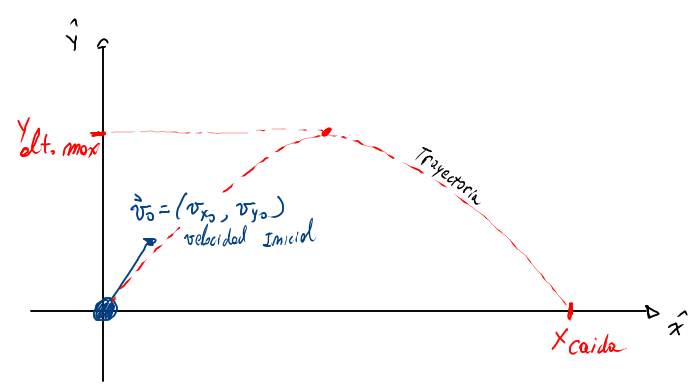
Where \vec{v}_{0} = (v_{0x},v_{0y}) is the initial velocity, \vec{r}_0=(x_0,y_0) is the initial position, and g=9.81[m/s^2] is the magnitude of the acceleration due to gravity. Now, if we observe the previous paragraph, we will notice that the velocity of the projectile is not directly indicated, but its speed and launch angle are. From this information and a bit of trigonometry, it is possible to determine the initial velocity because:
\begin{array}{rl} v_{0x} &= v_0 \cos(\theta) \\ v_{0y} &= v_0 \sin(\theta) \end{array}
Where v_0 = \|\vec{v}_0\| is the magnitude of the initial velocity. If we also add the initial position (x_0,y_0)=(0,0), the trajectory equations are expressed as follows:
\begin{array}{rl} \vec{a}(t) & = (0,-g) \\ \\ \vec{v}(t) & =(v_{0}\cos(\theta), -gt+v_{0}\sin(\theta)\\ \\ \vec{r}(t) & \displaystyle =\left(v_{0}\cos(\theta)t , -\frac{1}{2}gt^2+v_{0}\sin(\theta)t \right) \end{array}
With this at hand, we can answer some questions related to projectile motion: How far will it go? What height will it reach? How long will it take to fall? etc.
How to Determine the Maximum Height Reached by a Projectile?
To answer this question we must ask ourselves: What happens when the projectile reaches its maximum height? What happens is that the vertical component of its velocity becomes zero, and therefore:
-gt+v_{0}\sin(\theta) = 0
This is equivalent to saying that:
t = \displaystyle \frac{v_{0}\sin(\theta)}{g}
That is, the projectile reaches the maximum height after a time t=v_0\sin(\theta)/g from the launch. We call this “time to maximum height” and write:
\color{blue}{t_{alt.max} = \frac{v_{0}\sin(\theta)}{g}}
Then, the maximum height that the projectile can reach can be obtained by replacing t=t_{alt.max} in the vertical component of the projectile’s position, obtaining:
\begin{array}{rl} y_{alt.max} & = \displaystyle -\frac{1}{2}gt_{alt.max}^2+v_{0}\sin(\theta)t_{alt.max}\\ \\ & =\displaystyle-\frac{1}{2}g \left(\frac{v_{0}\sin(\theta)}{g} \right)^2 + v_{0}\sin(\theta) \frac{v_{0}\sin(\theta)}{g} \\ \\ & =\displaystyle-\frac{1}{2} \frac{v_{0}^2\sin^2(\theta)}{g} + \frac{v_{0}^2\sin^2(\theta)}{g} \\ \\ & =\displaystyle \frac{v_{0}^2\sin^2(\theta)}{2g} \end{array}
How to Determine the Range of Projectile Motion?
If you want to know the distance the projectile travels until it hits the ground, all you have to do is ask the trajectory equations associated with projectile motion. But how do we do that? Simple: What happens when the projectile touches the ground? What happens is that the position coordinate associated with height becomes zero, that is:
\displaystyle -\frac{1}{2}gt^2+v_{0}\sin(\theta)t = 0
Here we can solve for the time when the projectile hits the ground, which happens twice: at the moment of launch and when it falls because the possible solutions to this equation are:
\begin{array}{rl} t & = 0\\ \\ t & = \displaystyle \frac{2v_0 \sin(\theta)}{g} \end{array}
We call the non-zero result “fall time” and write:
\color{blue}{t_{caida} = \displaystyle \frac{2v_0 \sin(\theta)}{g}}
If you look above, you will notice that t_{caida} = 2t_{alt.max} because the time it takes for the projectile to reach its maximum height is the same as the time it takes to fall from its highest point. This indicates a certain symmetry in projectile motion. In fact, this symmetry is already evident when you notice that the height coordinate is parabolic.
Knowing the fall time, it is now possible to calculate the distance the projectile has traveled when it touches the ground by simply substituting it into the first position coordinate:
\begin{array}{rl} x_{caida} &= v_{0}\cos(\theta)t_{caida} \\ \\ & = \displaystyle v_{0}\cos(\theta)\frac{2v_0 \sin(\theta)}{g} \\ \\ & = \displaystyle \frac{v_0^2 \sin(2\theta)}{g} \\ \\ \end{array}
What Launch Angle Maximizes the Projectile Range?
If you want to know what angle of launch maximizes the range of projectile motion, or you want to prove that what you know is indeed correct, all you have to do is take from the expressions we have demonstrated the one that allows you to formulate the question mathematically. We have already calculated the fall distance in the previous section, and it turns out to be a function of the launch angle:
\displaystyle x_{caida} = x_{caida}(\theta) = \frac{v_0^2 \sin(2\theta)}{g}
The sine function has two possible extreme results: +1 and -1, but we are interested in the former. For \sin(2\theta)=+1 it is necessary that 2\theta = 90^o (+2k\pi, but we will omit that part because we don’t need it) and therefore \theta=45^o is the launch angle that maximizes the range. This problem can also be solved by formulating it as an optimization problem (using the tools of this calculus class) but I have opted for this path which is quicker and equally illustrative.
Proposed Exercises
- A projectile is launched from the ground with an elevation angle of \theta=30^o and an initial speed v_0=70[km/h]. a) What is the maximum height reached by the projectile? b) What distance does the projectile travel until it hits the ground? c) How long does it take for the projectile to fall?
- A cannon placed on the ground fires a bullet with a speed of 90[km/h] What elevation angle should the cannon be adjusted to so that the bullet falls at a horizontal distance of 20[m]?
- The same cannon from the previous exercise is now placed at a height of 5[m] What elevation angle should be adjusted so that the bullet still falls at a horizontal distance of 20[m]?
- A bomber flies at a height of 3,000[m] above the ground with a speed of 1,500[km/h]. If it drops a projectile by its own weight, what distance will the projectile travel from the moment it is dropped until it hits the ground?