

 Español
 Português
 中文 (中国)
 العربية
 हिन्दी
 Русский
 Français
 Deutsch
 Ελληνικά
 Italiano
 日本語
日本語 한국어
한국어 Latine
Summary
This lesson teaches how to write running text with the precision that typesetting demands. It distinguishes the paragraph, which is opened by a blank line or by \par, from the mere line break, \\ or \newline, and explains why a line break must not stand in for a paragraph. It presents vertical space and the reason to use it sparingly; the horizontal spaces: the interword space, the tie that keeps the line from breaking, the thin space and the space after a period, which babel adjusts according to the language; the four signs that the keyboard merges into one, the hyphen, the en dash, the em dash and the minus sign, with their use in English typography and in that of other languages; quotation marks, typed directly or with csquotes; the ellipsis; the direct Unicode input that LuaLaTeX accepts; and numbers, whose decimal and thousands separators and percentages follow conventions that LaTeX does not apply by itself, and which babel, in some languages, changes in ways worth knowing before they come as a surprise.
Learning objectives
- Separate paragraphs with blank lines and reserve the line break for the cases in which the line, not the paragraph, is the unit.
- Choose, for each pair of words or numbers, between the ordinary space, the tie, the thin space and no space at all.
- Write the hyphen, the en dash, the em dash and the minus sign where each belongs, according to the typographic convention of the language.
- Compose quotations on several levels in English, typed directly or with
\enquote, and the ellipsis. - Predict how LaTeX composes decimals, thousands and percentages in the text and in formulas, and write them so that the result follows English conventions.
Paragraphs and line breaks
For LaTeX, the source is divided not into lines but into paragraphs. A line break in the source is equivalent to a space, and several consecutive spaces are equivalent to one; a blank line, on the other hand, ends the paragraph, and several consecutive blank lines are equivalent to one. The command \par does exactly the same as the blank line: in fact, the engine turns every blank line into a \par. Within a paragraph, the engine decides where each line ends, taking the whole paragraph into account, as seen in the first lesson; between paragraphs, it applies the rules of the document class: the indent of the first line, the vertical space that separates them, the reluctance to leave a single line alone at the foot or at the head of a page.
The line break inside the first paragraph of the source does not appear in the result; the two consecutive blank lines produce a single change of paragraph, just like \par.
\documentclass{article}\usepackage{fontspec}\usepackage[english]{babel}\begin{document}\section{Hypothesis}The first paragraph of a section is not indented,as English typography requires.A blank line opens a new paragraph.Two blank lines also open just one.\par The par command does the same.\end{document}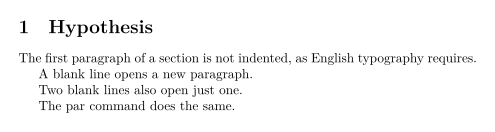
The first paragraph after the heading has no indent because that is the Anglo-American convention, which LaTeX follows by default and babel keeps for English. Other languages indent it, and babel applies their convention when the language is chosen: with \usepackage[french]{babel} or \usepackage[spanish]{babel}, that first paragraph is set with its indent, like the others.
The line break, \\ or its equivalent \newline, ends the line at that point without ending the paragraph: the next line belongs to the same paragraph, begins without an indent and is not separated from the previous one. The form \\[6pt] adds vertical space below the broken line, and the form \\*, as seen in the lesson on the anatomy of a document, also prevents the page from breaking at that point.
\documentclass{article}\usepackage{fontspec}\usepackage[english]{babel}\begin{document}First line of a paragraph,\\second line of the same paragraph,\newlinethird line,\\[6pt]and a fourth one, after some extra space.A true paragraph begins with its indent.\end{document}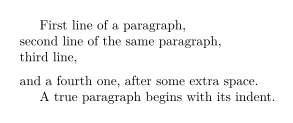
Now, a line break is not a paragraph, and using it as one is the most frequent typesetting error of those who come from a word processor. There are three reasons. First: the shape of the paragraphs is decided by the class, and a document that separates its paragraphs with line breaks has, for the engine, only one; if the class is later changed, or more space between paragraphs is requested, the true paragraphs change and the false ones do not. Second: the rules that protect the paragraph, such as the one that avoids leaving a stray line at the foot of the page, do not apply to what is not a paragraph. Third: the breaks used to leave empty lines produce box warnings with the maximum badness, and a break at the beginning of a paragraph is an error. The line break has its legitimate uses, in which the unit is the line: the lines of a poem, the lines of an address or those of a title set by hand.
Loading the content…
Completed
Sign in to save your progress