

The Intuitive Idea of Heat and Temperature
The heat of coffee, the cold of an ice cube, and the functioning of a refrigerator share a key concept: heat and its relationship with temperature. In this class, let’s explore how thermodynamics connects the intuitive with the scientific, through practical experiments and everyday applications that will help you understand thermal energy flow, natural heat patterns, and how it can be reversed in systems like refrigerators. With clear examples and practical calculations, this content will transform your perception of heat and its impact on our daily lives.
Learning Objectives:
By the end of this class, students will be able to:
- Understand the thermodynamic notion of heat as “thermal energy in transit.”
- Identify the natural direction of heat flow from a hot body to a cold one.
- Analyze how heat flow can be reversed under certain circumstances, such as in a refrigerator.
- Experience intuitive phenomena related to heat and temperature, such as the three-bucket experiment.
- Distinguish the thermal perception differences between materials with different conductivities, like metal and wood.
- Apply thermodynamic concepts to calculate energy transformed into heat in practical situations.
TABLE OF CONTENTS:
Experiments That Help Us Understand the Concept of Heat
The Three-Bucket Experiment
Contact with Wood and Metal
Thermodynamic Notion of Heat
In thermodynamics, there is a “natural direction” for heat flow
In thermodynamics, heat is a magnitude in transit
To understand the thermodynamic notion of heat, it is convenient to first approach the intuitive, and then move to something more formal. When we hold a jar of coffee or wash our face in the morning, we experience a sensation associated with cold or heat. But what does this thermal sensation mean? It turns out that it is not just a measure of temperature, but rather a combination of various data simultaneously.
Experiments That Help Us Understand the Concept of Heat
The Three-Bucket Experiment
Take three buckets, one with cold water and another with hot water, and a third with equal parts of the previous two. This last bucket will consequently have water at an intermediate temperature compared to the first two; it will be lukewarm. Place one hand in the bucket with hot water and the other in the cold water bucket. Wait a few seconds, and then place both hands in the lukewarm water bucket. The hand that was in the hot water will feel cold, and the hand that was in the cold water will feel warm.
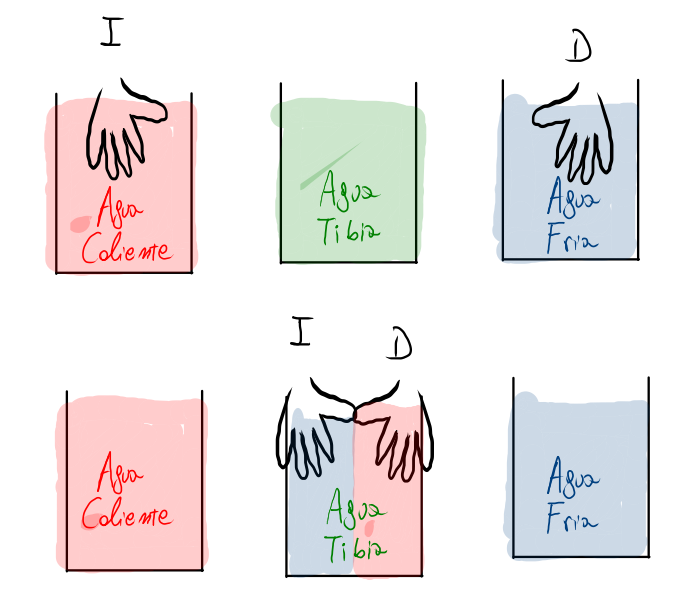
Why does this happen? The thermal sensation of our skin not only refers to a measure of temperature but also to temperature differences (relative to ours). We feel warm when something is at a higher temperature, and cold when it is at a lower temperature.
Contact with Wood and Metal
The previous experiment can be repeated with a variant: place a metal spoon and a wooden spoon in the hot water bucket for a few minutes, then remove them and touch them. You will notice that the metal spoon feels much hotter than the wooden one. Why is this? Both are at the same temperature, but metal is a much better conductor of heat than wood, which is why it feels “hotter.”
Thermodynamic Notion of Heat
In physics, when we talk about heat, we actually refer to “thermal energy in transit.” Of course, for this to be acceptable as a definition, we must clarify what “thermal energy” is in the first place, but we will leave that for later. For now, we will intuitively understand thermal energy as a form of energy proportional to temperature. And what is temperature? We will also leave that for later. For now, we will focus on the fact that heat is a certain energy flow that satisfies some qualities:
In thermodynamics, there is a “natural direction” for heat flow
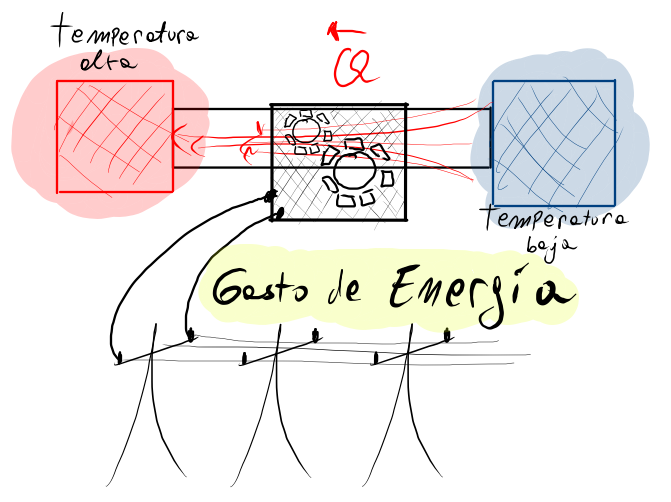
Experiments suggest that heat spontaneously transfers from a hot body to a colder one when they come into contact, and never in the opposite direction. 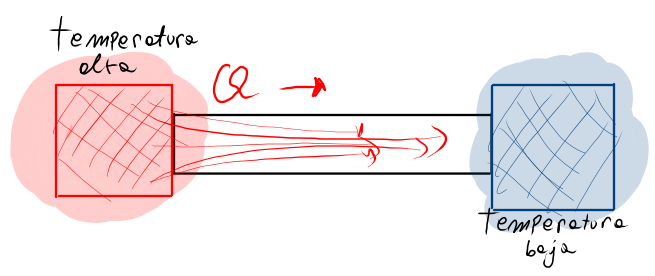 However, under certain circumstances, it can occur in the reverse direction, as in refrigerators; of course, this is achieved at a cost: energy needs to be supplied to the refrigerator to achieve this effect. This example shows that it is possible to reverse “natural heat flow,” but only if the price is paid with energy.
In thermodynamics, heat is a magnitude in transit
The expression “in transit” that appears when trying to define heat is important. Although we can “add” heat to a given object, we cannot say that a certain object “has heat,” as if we were talking about a jar containing a certain amount of water or a battery storing a certain amount of electrical energy. There is no “meter” to indicate “how much heat a certain object has” because heat only makes sense when it is “in transit.” Something similar happens with work. We can perform work on a certain object, consequently changing its state in some way, but we cannot say we have stored work in the system. Instead, we say that while certain work was performed, the state of the system changed, and similarly, this occurs with heat.
Example
An electric kettle of 1[kW] has been turned on for 5 minutes. How much energy has been transformed into heat?
The energy transformed into heat will be:
E=1[kW] \cdot 5[min]= 1000 \left[\dfrac{J}{s}\right] \cdot 5 \left[60 [s] \right] = 30.000[J]