Methods of Electrification by Contact, Friction, and Induction
In this class, we will review the three methods of electrification: contact, friction, and induction. The atomic structure of matter is introduced, differentiating between conductors and insulators. It describes how bodies gain or lose electric charge through these methods, highlighting that induction does not require direct contact between the objects involved.
Learning Objectives:
By the end of this class, the student will be able to:
- List the subatomic particles and their respective charges and masses.
- Explain why certain materials acquire electric charge when rubbed.
- Describe the relationship between the behavior observed by the Greeks (charged amber) and the modern notion of electricity.
- Differentiate between neutral atoms, cations, and anions.
- Use the law of charges to predict interactions between electric charges.
CONTENT INDEX
Conductors and Insulators
Electrification
Charging by Contact
Charging by Friction
Charging by Induction
Conductors and Insulators
Atoms that make up the internal structure of matter consist of three types of particles: protons, neutrons, and electrons. Protons and neutrons form the atomic nucleus and are called nucleons, while electrons are located in outer layers in a kind of “orbital clouds.” Nucleons are held together due to nuclear forces and, except in very massive atoms prone to decay via radioactive processes, are not easily lost or gained. In contrast, the electrons in the outermost layers may have greater or lesser freedom of movement depending on the atom’s electronic configuration.
Based on this, we can categorize physical objects into two opposite types: conductors and insulators. While conductors are materials capable of easily acquiring and releasing electrons, insulators tend to resist the exchange of their electrons.
Although both conductors and insulators can lose or gain electrons, the fundamental distinction lies in the mobility of the electrons once they are captured by the material’s atoms. For instance, in most metals, electrons enjoy freedom of movement that allows the formation of “electric currents.” By contrast, in materials such as rubber, although they can acquire electric charge, it is difficult for charges to move from one point to another through them.
Electrification
Electrification refers to the phenomenon of gaining or losing electric charge. Below, we describe the processes by which this phenomenon occurs.
Charging by Contact
Charging by contact involves electrifying a body by bringing it into contact with another body that is already electrified. In doing so, electrons redistribute between both bodies until their charges reach equilibrium. For this process to occur, it is essential that both bodies are conductors; otherwise, charges will not freely redistribute, and electrification will not occur.
Below is a table summarizing the key aspects of charging by contact.
| Initial Charge States | Contact Process | Final Charge States | Observation | ||
| (+) | Neutral | \left. \right> | (+) | (+) | The positive charge is distributed between the two bodies |
| (+) | (-) | \left. \right> | (+) | (+) | Charges counteract, leaving the dominant charge |
| (+) | (-) | \left. \right> | Neutral | Neutral | Equal and opposite charges cancel out |
| (-) | (+) | \left. \right> | (-) | (-) | Charges counteract, leaving the dominant charge |
| (-) | Neutral | \left. \right> | (-) | (-) | The negative charge is distributed between the two bodies |
Charging by Friction
When rubbing one body against another, a slight increase in temperature occurs. This is because, during rubbing, energy is transferred between the bodies. Part of this energy can displace electrons from one object to another. When this happens, we say that the bodies have acquired charge by friction. Unlike charging by contact, in charging by friction, two neutral bodies end up having charges of equal magnitude but opposite signs.
Below is a table summarizing the main aspects of charging by friction.
| Initial Charge States | Friction Process | Final Charge States | Observation | ||
| Neutral | Neutral | \left. \right> | (+) | (-) | One body gives electrons to the other, leaving one positively charged and the other negatively charged |
Charging by Induction
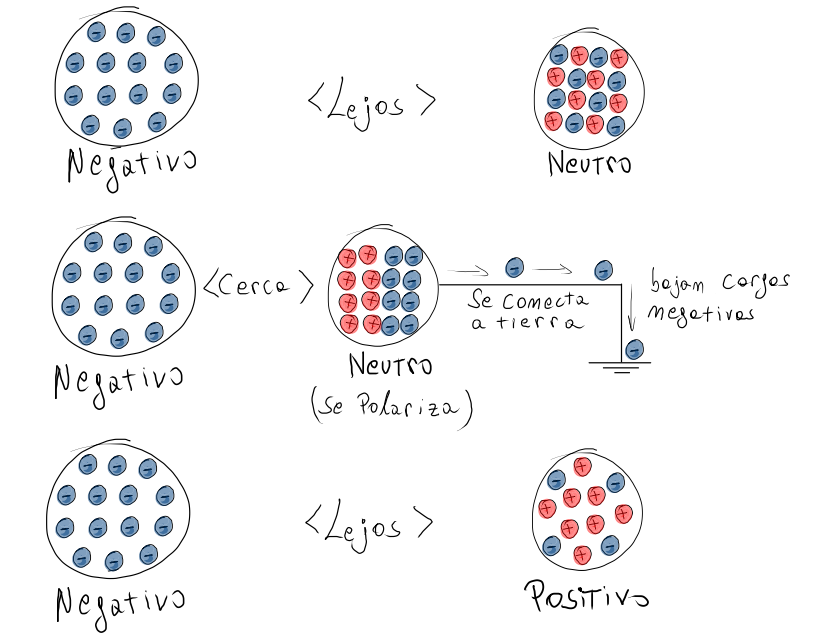
Among the methods of electrification we have analyzed, charging by induction stands out as the only one that does not require direct contact between the objects involved. In this method, the effect of the electric field of a charged object on the electrons of a neutral body is used. To understand this mechanism, it is essential to know that electrons, which have a negative charge, can be attracted or repelled in the presence of another charged object. Furthermore, it is crucial to understand that the ground connection acts as a source or reservoir of electrons, depending on the case.
Induction from Neutral to Negative
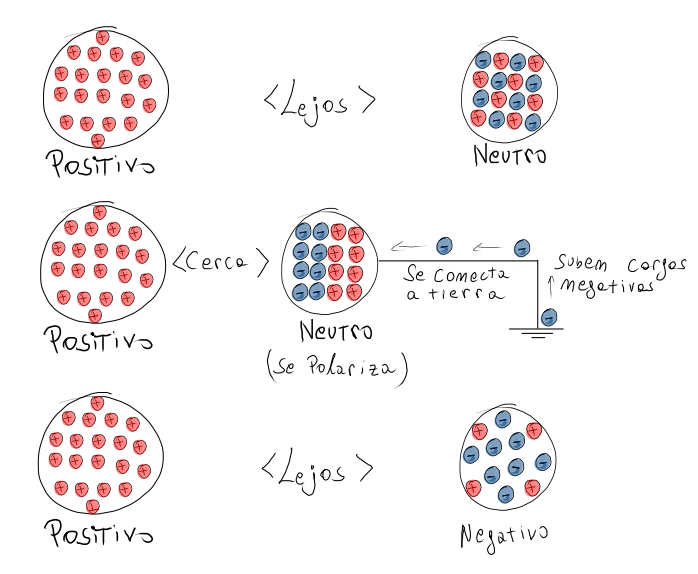
Induction from Neutral to Positive