

Infinite Limits and Divergence
Summary:
In this class, we will address infinite limits and the different types of divergence in limits, exploring fundamental concepts to understand how certain functions do not converge to a defined real value. We will review disparate lateral limits, infinitely oscillating functions, and situations where limits do not exist due to domain issues or unbounded growth.
Learning Objectives:
By the end of this class, the student will be able to
- Define divergent limits and recognize when a limit is divergent.
- Identify the different types of divergence in limits, such as disparate lateral limits and infinite limits.
- Analyze situations where a function has domain issues and how this affects the existence of the limit.
- Evaluate lateral limits to determine if they are disparate and the impact on limit convergence.
- Calculate infinite limits and distinguish between limits that diverge toward positive and negative infinity.
CONTENT INDEX:
When do we say a limit is divergent?
Types of Divergence in Limits
Limits with Domain Issues
Disparate Lateral Limits
Limits of Infinitely Oscillating Functions
Infinite Limits
Infinite Limits at Infinity
This time, we will not only review Infinite Limits but also divergent limits in general. Divergent limits tell us about how a function seems not to converge, and this can occur in many ways.
When do we say a limit is divergent?
We say a limit is divergent when it does not converge to any real value. This, which sounds obvious, can occur in different ways:
- When the lateral limits are different or non-existent, bilateral limits do not exist.
- If the function is not well-defined, grows without limit, or oscillates infinitely as it approaches the point where the limit is calculated, then the lateral limit cannot exist.
This can apply, with its particularities, to both finite limits and limits at infinity, and depending on the case, we will have some type of divergence.
Types of Divergence in Limits
Limits with Domain Issues
When we try to calculate a limit of the type \lim_{x\to x_0}f(x) or \lim_{x\to +\infty}f(x), we expect at least that f(x) is well-defined for values close to x_0 or for some interval of the form [a,+\infty[, respectively. If such a thing does not happen, then neither definition of limits could even make sense; the function cannot “tend” to some value if it approaches from where it is not even defined. In such cases, we simply write that the limit does not exist: \lim_{x\to x_0}f(x)=\cancel{\exists} and \lim_{x\to +\infty}f(x)=\cancel{\exists}, as appropriate. Similarly, this applies to lateral limits, and nothing more can be said about this type of situation.
Disparate Lateral Limits
Consider a function of the type f(x) = x/|x| and calculate the limit when x\to 0. The first thing we notice will be that
\displaystyle\lim_{x\to 0^+} f(x) = 1
\displaystyle\lim_{x\to 0^-} f(x) = -1
In this case, we note that while the lateral limits exist, they are different. When this occurs, we simply say that the (bilateral) limit does not converge, and therefore:
\displaystyle\lim_{x\to 0} f(x) = \cancel{\exists}
Limits of Infinitely Oscillating Functions
There is also the case where functions, instead of approaching a certain value, begin to oscillate within a certain range. An example of this would be a function of the type f(x)= \sin(1/x). If we observe what happens with this function when x\to 0, we will see that it oscillates infinitely.
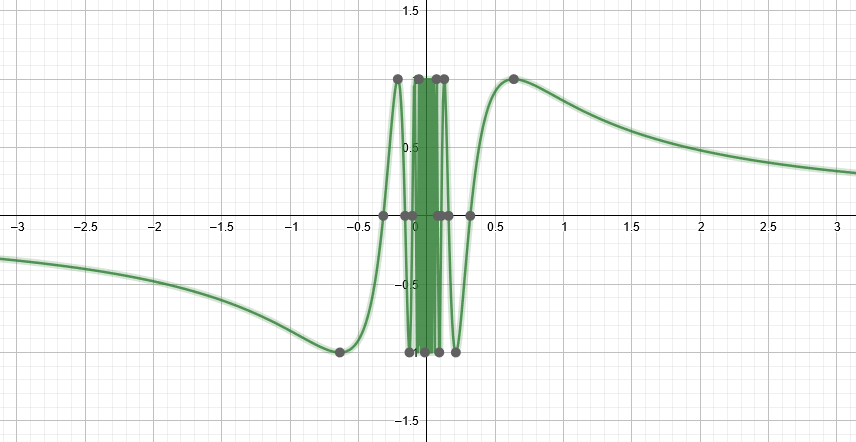
When similar things happen, we say that the limit simply does not exist.
Infinite Limits
Let’s see what happens with the function f(x) = 1/x. The first thing we will see is that when x\to 0, the value of f(x) grows without limit, but the way it will do so will depend on where the limit is calculated from. Intuitively, we will write
\displaystyle\lim_{x\to 0^+} \dfrac{1}{x} = +\infty
\displaystyle\lim_{x\to 0^-} \dfrac{1}{x} = -\infty
With this notation, we are not saying that the limit exists in some way; instead, we are indicating how this limit does not exist. Unlike previous cases, where the limit does not exist and does not converge to a specific value; in this case, it diverges because its size goes beyond any real number.
What we just reviewed can be formalized through the following definitions:
\displaystyle\lim_{x\to x_0^+}f(x) = +\infty := \left(\forall M \in \mathbb{R}\right)\left( \exists \delta \gt 0 \right) ( x_0 \lt x \lt x_0 + \delta \rightarrow M \lt f(x) )
\displaystyle\lim_{x\to x_0^-}f(x) = +\infty := \left(\forall M \in \mathbb{R}\right)\left( \exists \delta \gt 0 \right) ( x_0 - \delta \lt x \lt x_0 \rightarrow M \lt f(x) )
\displaystyle\lim_{x\to x_0}f(x) = +\infty := \left(\lim_{x\to x_0^+}f(x) = +\infty \right) \wedge \left(\lim_{x\to x_0^-}f(x) = +\infty \right)
And similarly:
\displaystyle\lim_{x\to x_0^+}f(x) = -\infty := \left(\forall m \in \mathbb{R}\right)\left( \exists \delta \gt 0 \right) ( x_0 \lt x \lt x_0 + \delta \rightarrow f(x) \lt m )
\displaystyle\lim_{x\to x_0^-}f(x) = -\infty := \left(\forall m \in \mathbb{R}\right)\left( \exists \delta \gt 0 \right) ( x_0 - \delta \lt x \lt x_0 \rightarrow f(x) \lt m )
\displaystyle\lim_{x\to x_0}f(x) = -\infty := \left(\lim_{x\to x_0^+}f(x) = -\infty \right) \wedge \left(\lim_{x\to x_0^-}f(x) = -\infty \right)
Sometimes, we also talk about limits that tend to infinity (without sign)
\displaystyle\lim_{x\to x_0}f(x) = \infty := \lim_{x\to x_0}|f(x)| = +\infty
Infinite Limits at Infinity
Similarly to the limits reviewed above, it is possible to define infinite limits at infinity. For example:
\displaystyle\lim_{x\to +\infty}f(x) = +\infty := \left(\forall M \in \mathbb{R}\right)\left( \exists N \in\mathbb{R} \right) ( N\lt x \rightarrow M \lt f(x) )
And with this, we have seen all the ways in which functions’ limits can diverge.