Thermodynamic Limit, Pressure, and Extensive and Intensive Variables Summary: This class introduces the concept of the Thermodynamic Limit to explain how some physical systems are treated statistically. An analogy of particles colliding with a wall is used, where pressure is defined as the total force per unit area. By considering...
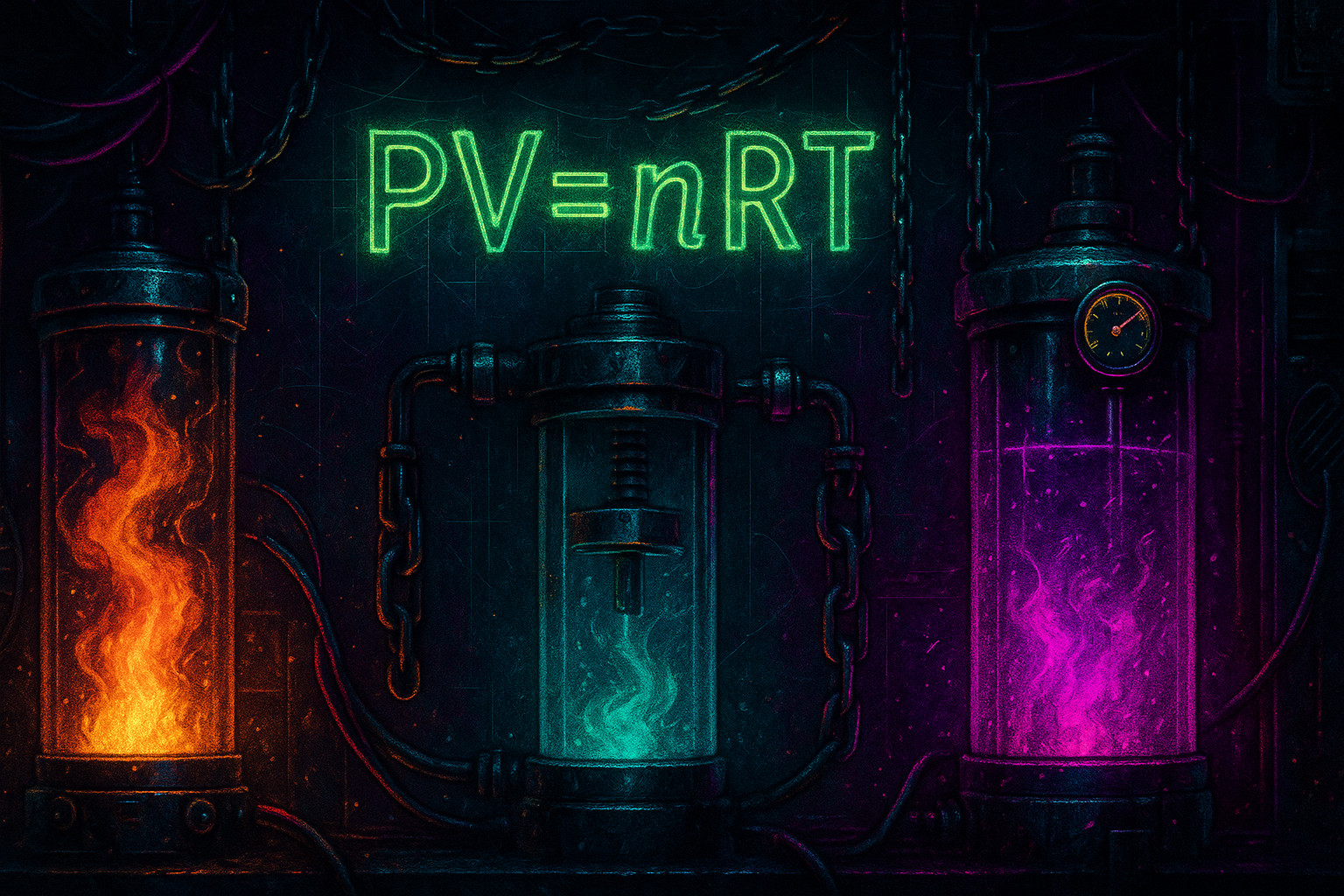
Empirical Formulation of the Ideal Gas Have you ever wondered why a balloon expands when heated or why a tire’s pressure changes with altitude? In this lesson, we will review the laws governing these behaviors and how they lead to the ideal gas equation, along with its considerations and key...
Mole and Molar Mass in Thermodynamics Summary: The class introduces the mole and molar mass in thermodynamics, highlighting the importance of the relationships between particles in an object. It explains the need for statistical approaches for systems with many particles. The mole is defined with Avogadro's Number, and it shows...
The Stirling Formula The Stirling formula is an essential tool for simplifying calculations with factorials of large numbers, offering a quick and practical approximation. This result is especially useful in areas such as thermodynamics, probability, and asymptotic analysis, where working with extremely large numbers is common. Understanding its derivation not...
Combinatorics Problems in Thermodynamics How many ways are there to organize a physical system composed of millions of elements? In this class, we will explore how mathematics allows us to answer questions like this in the context of thermodynamics, from the distribution of energy quanta in atomic systems to calculating...
Exercises: Moles, Combinatorics, and Large Numbers Now is the time to apply what you have learned with practical exercises that will help you master essential thermodynamic concepts, such as moles, combinatorics, and calculations with large numbers. If you haven’t done so already, I recommend reviewing the previous lessons, as they...
The Intuitive Idea of Heat and Temperature The heat of coffee, the cold of an ice cube, and the functioning of a refrigerator share a key concept: heat and its relationship with temperature. In this class, let's explore how thermodynamics connects the intuitive with the scientific, through practical experiments and...
The Heat Capacity Have you ever wondered what really happens when you heat an object? The heat capacity is the key to understanding this fundamental phenomenon that connects energy, temperature, and the physical states of matter. This fascinating concept not only explains why water takes longer to heat up than...
Boltzmann Distribution in the Canonical Ensemble Thermodynamics reveals how physical systems reach equilibrium and how energy and probability determine their behavior. In this lesson, we will unravel the canonical ensemble and the Boltzmann Distribution, fundamental tools to understand phenomena like chemical reactions and equilibrium in complex systems. You will discover...
Temperature, Thermodynamic Equilibrium, and the Zeroth Law Temperature is not just an indicator of cold or heat; it is a fundamental magnitude to understand how physical systems reach equilibrium. In this context, the Zeroth Law of Thermodynamics and its relationship with temperature measurement play a crucial role in explaining why...