

Conic Sections: Characterization and Graph of Parabolas, Ellipses, and Hyperbolas
Summary:
In this class, we will review the conic sections (parabolas, ellipses, and hyperbolas), starting with their canonical and general equations. We explain how to identify and characterize each curve, focusing on key elements such as the vertex, focus, and axis of symmetry in parabolas, and the distinction between ellipses and hyperbolas according to the signs of their coefficients.
Learning Objectives:
By the end of this class, the student will be able to:
- Recognize the canonical equations of conic sections (parabolas, ellipses, hyperbolas)
- Calculate each characteristic of the conic sections: length of semi-axes, focal distance, directrix, etc.
CONTENT INDEX
Conic sections
Review of Parabolas
Review of Ellipses and Hyperbolas
Characterization of the Ellipse
Characterization of the Hyperbola
Solved Exercises
Conic Sections
Conic sections are the curves that result from intersecting the surface of a cone with a plane. The family of conic sections includes circles and ellipses, and hyperbolas, all of which we have already studied.
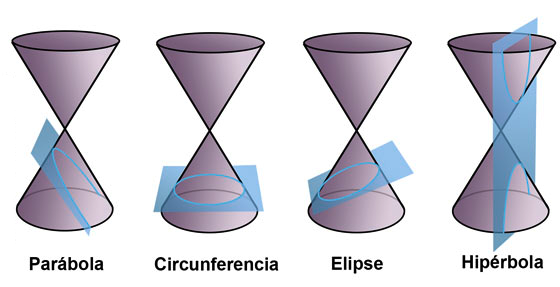
Now we will review the techniques for recognizing and characterizing each of these curves. We will especially focus on the canonical forms because these are the ones most frequently encountered and reveal the least explicit information. The general equations, on the other hand, reveal almost all the geometric characterization.
Review of Parabolas
Every parabola is represented by an equation of the form
y=ax^2 + bx + c, with a\neq 0
In terms of this, we obtained:
- Vertex Coordinates: \displaystyle (x_0, y_0)=\left( -\dfrac{b}{2a}, c - \dfrac{b^2}{4a} \right)
- Focal Position: \displaystyle f=\dfrac{1}{4a}
- Focus Coordinates: \displaystyle foco=\left( -\dfrac{b}{2a}, c - \dfrac{b^2}{4a} + f \right) =\left( -\dfrac{b}{2a}, c + \dfrac{1- b^2}{4a} \right)
- Equation of the Directrix: \displaystyle y= c - \dfrac{b^2}{4a} - f = c - \dfrac{1+b^2}{4a}
- Equation of the Axis of Symmetry: \displaystyle x= -\dfrac{b}{2a}
- Intersections with the x-axis (if they exist): \displaystyle x_{1,2}= \dfrac{-b \pm \sqrt{b^2-4ac}}{2a}
With this, we have all the necessary information to graph any parabola.
Review of Ellipses and Hyperbolas
Ellipses and hyperbolas, as we have seen, have a canonical expression of the form.
Ax^2 + Bx + Cy^2 + Dy + E = 0
Where A and C are constants different from zero, and from what we have studied, it follows that:
- If A and C have the same sign, it is an ellipse.
- If A and C have opposite signs, it is a hyperbola.
To clearly separate both cases, we will write:
- \alpha x^2+ \beta x + \gamma y^2 + \delta y + \epsilon = 0 is an ellipse.
- \alpha x^2+ \beta x - \gamma y^2 + \delta y + \epsilon = 0 is a hyperbola.
Where \alpha, \beta, \gamma, \delta and \epsilon are any real numbers and \alpha and \gamma are always positive. Writing it this way allows us to clearly separate both cases. From this, we can make the following inferences:
Characterization of the Ellipse
Starting from the canonical equation, we have the following deduction:
| (1) | \alpha x^2+ \beta x + \gamma y^2 + \delta y + \epsilon = 0 | ; canonical equation of ellipses. |
| (2) | \displaystyle \alpha \left( x^2+ \dfrac{\beta}{\alpha }x\right) + \gamma \left(y^2 + \dfrac{\delta}{\gamma }y\right) =- \epsilon | ; factoring and regrouping terms |
| (3) | \displaystyle \alpha \left( x + \dfrac{\beta}{2 \alpha }\right)^2 + \gamma \left(y + \dfrac{\delta}{2 \gamma } \right)^2 =\dfrac{\beta^2}{4\alpha } + \dfrac{\delta^2}{4\gamma } - \epsilon | ; completing squares and regrouping terms |
| (4) | \displaystyle \alpha \dfrac{\left( x + \dfrac{\beta}{2 \alpha }\right)^2}{\left(\dfrac{\beta^2}{4\alpha } + \dfrac{\delta^2}{4\gamma } - \epsilon\right)} + \gamma \dfrac{\left(y + \dfrac{\delta}{2 \gamma } \right)^2}{\left(\dfrac{\beta^2}{4\alpha } + \dfrac{\delta^2}{4\gamma } - \epsilon\right)} = 1 | ; dividing everything by \displaystyle \dfrac{\beta^2}{4\alpha } + \dfrac{\delta^2}{4\gamma } - \epsilon |
| (5) | \displaystyle \dfrac{\left( x + \dfrac{\beta}{2 \alpha }\right)^2}{\dfrac{1}{\alpha }\left(\dfrac{\beta^2}{4\alpha } + \dfrac{\delta^2}{4\gamma } - \epsilon\right)} + \dfrac{\left(y + \dfrac{\delta}{2 \gamma } \right)^2}{\dfrac{1}{ \gamma}\left(\dfrac{\beta^2}{4\alpha } + \dfrac{\delta^2}{4\gamma } - \epsilon\right)} = 1 | ; rearranging \alpha and \gamma |
| (6) | \displaystyle \left( \dfrac{ x - \left(-\dfrac{\beta}{2 \alpha }\right)}{\sqrt{\dfrac{1}{\alpha}\left(\dfrac{\beta^2}{4\alpha } + \dfrac{\delta^2}{4\gamma } - \epsilon\right)}}\right)^2 + \left( \dfrac{y - \left(-\dfrac{\delta}{2 \gamma } \right)}{\sqrt{\dfrac{1}{\gamma}\left(\dfrac{\beta^2}{4\alpha } + \dfrac{\delta^2}{4\gamma } - \epsilon\right)}}\right)^2 = 1 | ; restructuring with square roots |
In the development of this deduction, step (3) is particularly delicate, because if the coefficient \displaystyle \dfrac{\beta^2}{4\alpha } + \dfrac{\delta^2}{4\gamma } - \epsilon is negative, then the ellipse cannot exist.
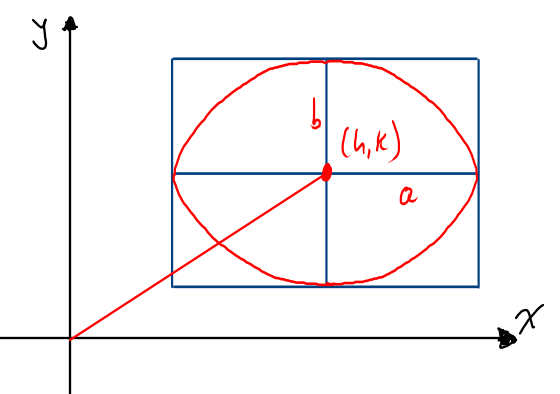
Recall that the general equation for ellipses is of the form
\displaystyle \left( \dfrac{x-h}{a} \right)^2 + \left(\dfrac{y-k}{b} \right)^2 = 1
With this last result, we now have a direct relationship between the parameters of the general formula that allows us to reveal all the information hidden in the canonical expression:
- Center coordinates: \displaystyle (h,k) = \left( -\dfrac{\beta}{2\alpha}, -\dfrac{\delta}{2\gamma}\right)
- Length of the horizontal semi-axis: \displaystyle a = \sqrt{\dfrac{1}{\alpha}\left(\dfrac{\beta^2}{4\alpha } + \dfrac{\delta^2}{4\gamma } - \epsilon\right)}
- Length of the vertical semi-axis: \displaystyle b = \sqrt{\dfrac{1}{\gamma}\left(\dfrac{\beta^2}{4\alpha } + \dfrac{\delta^2}{4\gamma } - \epsilon\right)}
With this, it is now possible to recognize and graph an ellipse directly from its canonical form. Its graph will look like this:
Characterization of the Hyperbola
Reasoning in a completely analogous way, you can make the complete characterization of hyperbolas starting from the canonical equation. In fact, the analysis is so analogous that I will copy and paste the ellipse analysis and only modify a few parts.
| (1) | \alpha x^2+ \beta x - \gamma y^2 + \delta y + \epsilon = 0 | ; canonical equation of hyperbolas. |
| (2) | \displaystyle \alpha \left( x^2+ \dfrac{\beta}{\alpha }x\right) - \gamma \left(y^2 - \dfrac{\delta}{\gamma }y\right) =- \epsilon | ; factoring and regrouping terms |
| (3) | \displaystyle \alpha \left( x + \dfrac{\beta}{2 \alpha }\right)^2 - \gamma \left(y - \dfrac{\delta}{2 \gamma } \right)^2 =\dfrac{\beta^2}{4\alpha } - \dfrac{\delta^2}{4\gamma } - \epsilon | ; completing squares and regrouping terms |
| (4) | \displaystyle \alpha \dfrac{\left( x + \dfrac{\beta}{2 \alpha }\right)^2}{\left(\dfrac{\beta^2}{4\alpha } - \dfrac{\delta^2}{4\gamma } - \epsilon\right)} - \gamma \dfrac{\left(y - \dfrac{\delta}{2 \gamma } \right)^2}{\left(\dfrac{\beta^2}{4\alpha } - \dfrac{\delta^2}{4\gamma } - \epsilon\right)} = 1 | ; dividing everything by \displaystyle \dfrac{\beta^2}{4\alpha } - \dfrac{\delta^2}{4\gamma } - \epsilon |
| (5) | \displaystyle \dfrac{\left( x + \dfrac{\beta}{2 \alpha }\right)^2}{\dfrac{1}{\alpha}\left(\dfrac{\beta^2}{4\alpha } - \dfrac{\delta^2}{4\gamma } - \epsilon\right)} - \dfrac{\left(y - \dfrac{\delta}{2 \gamma } \right)^2}{\dfrac{1}{\gamma}\left(\dfrac{\beta^2}{4\alpha } - \dfrac{\delta^2}{4\gamma } - \epsilon\right)} = 1 | ; rearranging the terms \alpha and \gamma |
| (6) | \displaystyle \left( \dfrac{ x - \left(-\dfrac{\beta}{2 \alpha }\right)}{\sqrt{\dfrac{1}{\alpha}\left(\dfrac{\beta^2}{4\alpha } - \dfrac{\delta^2}{4\gamma } - \epsilon\right)}}\right)^2 - \left( \dfrac{y - \left(\dfrac{\delta}{2 \gamma } \right)}{\sqrt{\dfrac{1}{\gamma}\left(\dfrac{\beta^2}{4\alpha } - \dfrac{\delta^2}{4\gamma } - \epsilon\right)}}\right)^2 = 1 | ; restructuring with square roots |
From this, we now have a direct relationship between the canonical equation and the equation of hyperbolas that will allow us to quickly craft their graph.
\displaystyle \left(\dfrac{x-h}{a} \right)^2 - \left(\dfrac{y-k}{b} \right)^2 =1
Now, unlike what is done with ellipses, it is more appropriate here to talk about a “generating box” as we will see in the following figure shown later:
- Center coordinates: \displaystyle (h,k) = \left( -\dfrac{\beta}{2\alpha}, \dfrac{\delta}{2\gamma}\right)
- Length of the horizontal semi-axis: \displaystyle a = \sqrt{\dfrac{1}{\alpha}\left(\dfrac{\beta^2}{4\alpha } - \dfrac{\delta^2}{4\gamma } - \epsilon\right)}
- Length of the vertical semi-axis: \displaystyle b = \sqrt{\dfrac{1}{\gamma}\left(\dfrac{\beta^2}{4\alpha } - \dfrac{\delta^2}{4\gamma } - \epsilon\right)}
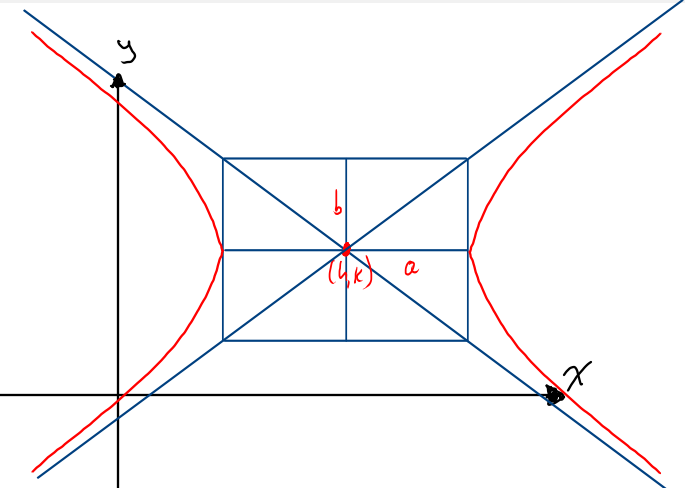
With the results of these analyses, we can now graph any member of the conic sections family without any special difficulty.