

Thermal Equilibrium, Temperature, and its Statistical Definition
Thermodynamic temperature, understood as the connection between energy and probability, arises from the balance between macrostates and microstates in thermal systems. This content explores how the maximization of the number of microstates defines thermal equilibrium, using mathematical deductions and the framework of statistical mechanics to explain its relationship with Boltzmann’s constant and the Kelvin scale.
Learning Objectives:
By the end of this lesson, the student will be able to:
- Understand the relationship between macrostates and microstates in thermodynamic systems and the concept of temperature.
CONTENT INDEX:
Macrostates and Microstates of Systems in Thermal Contact
Thermodynamic Temperature: The Common Quality of Systems in Equilibrium
Macrostates and Microstates of Systems in Thermal Contact
To address the concept of thermodynamic temperature, we must first examine how thermodynamic systems interact and their relationship with microstates and macrostates. Let us consider the case of two systems in thermal contact with each other but isolated from the rest of the universe.
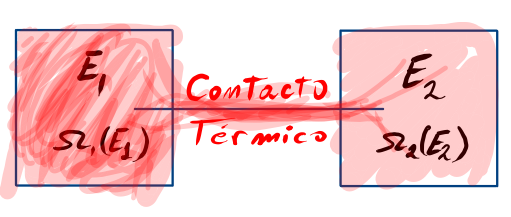
On one hand, since the systems remain isolated, the total energy E=E_1+E_2 will be constant, and thus the macrostate of the system is defined by any of the three energies E, E_1, and E_2. On the other hand, in terms of microstates, the system with energy E_1 has \Omega_1(E_1) microstates, and similarly, the system with energy E_2 has \Omega_2(E_2). Therefore, the combined system is composed of a total of \Omega_1(E_1)\Omega_2(E_2) microstates.
Assumptions about Thermodynamic Equilibrium
If each system can exchange energy until achieving thermodynamic equilibrium, at some point, E_1 and E_2 will approach constant values. The key idea to keep in mind here is that the macrostate with the highest probability of occurrence will be the one that maximizes the number of microstates. From this, the following assumptions arise:
- Each of the microstates has the same probability of occurring.
- The internal dynamics of the system are such that the microstates are in constant flux.
- After some time, the system will explore all possible microstates and will spend an equal amount of time in each one.
These assumptions imply that the system will spend most of its time in the macrostates representing the largest number of microstates, making them the most probable. Now, in the systems typically studied in thermodynamics, the term “most probable” essentially means “practically and overwhelmingly certain to occur”; what might seem like a mere statistical statement is, in fact, a declaration of near absolute certainty.
Thermodynamic Temperature: The Common Quality of Systems in Equilibrium
For our problem of two bodies placed in thermal contact, the most probable distribution of energy is the one that maximizes the number \Omega_1(E_1)\Omega_2(E_2) of microstates. Since the systems are vast, we can use the tools of differential calculus as a good approximation to infer the implications of these statements and deduce their properties.
If we make infinitesimal variations to the energy of one of the systems and seek the case where the number of microstates is maximized, we derive the following reasoning:
\begin{array}{rl} (1) & \dfrac{d}{dE_1}\left[ \Omega_1(E_1) \Omega_2(E_2) \right] = 0 \\ & \text{; Because the number of microstates has been maximized} \\ \\ \equiv & \dfrac{d\Omega_1(E_1)}{dE_1} \Omega_2(E_2) + \Omega_1(E_1) \dfrac{d\Omega_2(E_2)}{E_2}\dfrac{dE_2}{dE_1} = 0 \\ & \text{; Applying the product rule and the chain rule} \\ \\ (2) & E = E_1 + E_2 = \text{Constant} \\ & \text{; Total energy of the two systems in thermal contact} \\ \\ \equiv & E_1 = E - E_2 \\ \\ (3) & \dfrac{dE_2}{dE_1} = \dfrac{d}{dE_1} (E - E_1) = -1\;\text{; From (2)} \\ \\ (4) & \dfrac{d\Omega_1}{dE_1}\Omega_2 - \Omega_1 \dfrac{d\Omega_2}{dE_2} = 0\;\text{; From (1) and (3)} \\ \\ \equiv & \dfrac{d\Omega_1}{dE_1} \Omega_2 = \Omega_1 \dfrac{d\Omega_2}{dE_2} \\ \\ \equiv & \dfrac{1}{\Omega_1} \dfrac{d\Omega_1}{dE_1} = \dfrac{1}{\Omega_2} \dfrac{d\Omega_2}{dE_2} \\ \\ \equiv & \dfrac{d\ln(\Omega_1)}{dE_1} = \dfrac{d\ln(\Omega_2)}{dE_2} \end{array}
From this, we understand that since thermal equilibrium is the most probable macrostate of two bodies in prolonged thermal contact, it maximizes the number of microstates. If this occurs, the reasoning above shows that there exists a common quantity for both systems, which we call temperature.
Definition of Thermodynamic Temperature
When this happens, we say that the bodies “are at the same temperature,” and we relate d\ln\Omega/dE with the temperature T (such that T_1 = T_2). Thus, thermodynamic temperature is defined as:
\displaystyle \frac{1}{k_B T} = \frac{d\ln\Omega}{dE}
where k_B=1.3807\cdot 10^{-23}[J/K] is Boltzmann’s constant.
With this choice of constants, the temperature T we have defined acquires its usual interpretation in what we know as the Kelvin scale.