

The Derivative as the Limit of a Function
Abstract: In this lesson, we will explore the concept of the derivative as the mathematical tool to analyze changes in functions. Starting from the slope of a secant line, and taking the limit as the points get closer, we will define the derivative as the slope of the tangent line. Additionally, we will study its key properties and rules, such as sum, product, and quotient rules, which are fundamental for applying derivatives in the analysis of functions and phenomena of change.
Learning Objectives
By the end of this lesson, students will be able to:
- Understand the derivative as the limit describing the instantaneous change in a function and as the slope of the tangent line to a curve at a point.
- Explain how differentiability implies continuity in functions.
- Demonstrate the basic differentiation rules from the formal definition.
- Apply the properties of the algebra of derivatives (sum, product, and quotient) to mathematical problems.
TABLE OF CONTENTS:
The concept of the derivative
The slope of the secant line
Taking the limit: The derivative and the slope of the tangent line
Alternative definition
Properties of Derivatives
Differentiability implies continuity
Algebra of derivatives
The Concept of the Derivative
Nature is generally subject to change, and the quintessential mathematical tool for calculating and understanding change is the derivative. This arises from asking, “What happens to the value of a function f(x) when the variable x is increased or decreased by an arbitrarily small amount \Delta x?” The concept of the derivative emerges as the limit of a function when analyzing that question.
The Slope of the Secant Line
Consider a function f(x) evaluated at two points x_0 and x_0 + \Delta x. Any line cutting through two points of a curve is called a “secant line” and looks like the one in the figure below.
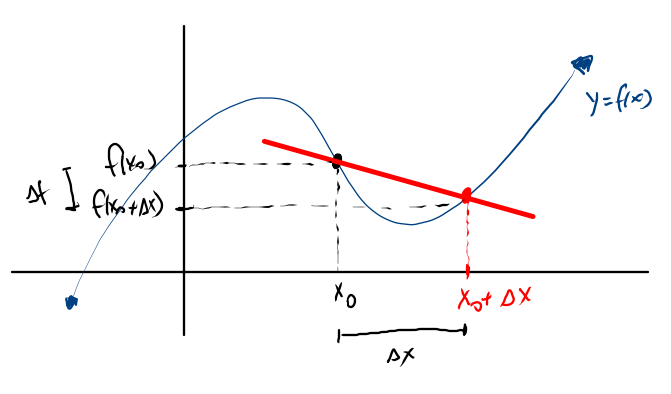
The slope of this secant line is given by:
\dfrac{\Delta f(x_0)}{\Delta x} = \dfrac{f(x_0 + \Delta x) - f(x_0)}{\Delta x}
Taking the Limit: The Derivative and the Slope of the Tangent Line
Consider the secant line of the curve y=f(x) passing through x_0 and x_0 + \Delta x. If we take the limit as \Delta x approaches zero, we obtain the tangent line to the curve at (x_0, f(x_0)).
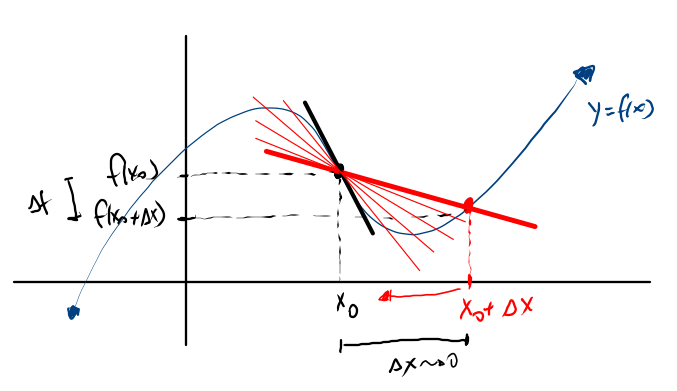
From this, the formal definition of the derivative of a function f(x) at a point x_0 is given as:
\displaystyle \dfrac{df(x_0)}{dx}:= \lim_{\Delta x \to 0}\dfrac{\Delta f(x_0)}{\Delta x} = \lim_{\Delta x \to 0} \dfrac{f(x_0 + \Delta x) - f(x_0)}{\Delta x}
This represents the slope of the tangent line passing through x_0.
Alternative Definition
An alternative way of presenting the definition of the derivative as a limit is derived from the following substitution:
\begin{array}{rl} x_i &= x_0\\ x_f &= x_i + \Delta x \end{array}
Thus, \Delta x = x_f - x_i, and the definition of the derivative becomes:
\begin{array}{rl} \displaystyle \dfrac{df(x_i)}{dx} &=\displaystyle \lim_{\Delta x \to 0}\dfrac{ f(x_i + \Delta x) - f(x_i)}{\Delta x}\\ \\ &=\displaystyle \lim_{x_f - x_i \to 0} \dfrac{f(x_f) - f(x_i)}{x_f - x_i}\\ \\ &=\displaystyle \lim_{x_f \to x_i } \dfrac{f(x_f) - f(x_i)}{x_f - x_i} \end{array}
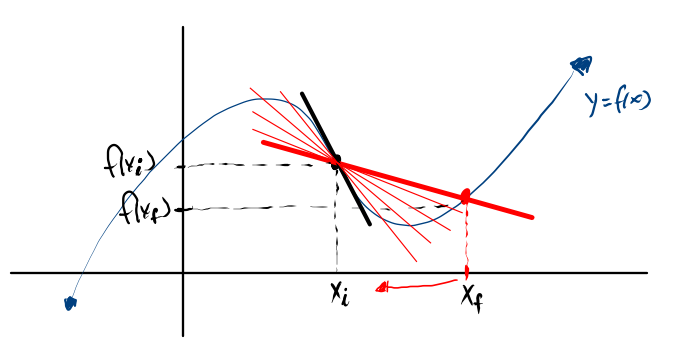
Both definitions are equivalent and can be used interchangeably, depending on convenience.
Properties of Derivatives
A function is said to be differentiable at x_0 if the following limit exists:
\displaystyle \lim_{\Delta x \to 0} \dfrac{f(x_0 + \Delta x) - f(x_0)}{\Delta x}
We say it is differentiable on a set I if the limit is well-defined for all x_0 \in I. Differentiable functions have the following properties:
Differentiability Implies Continuity
If a function is differentiable at x_0, then it is continuous at x_0. This can be proven through the following argument:
For f(x) to be continuous at x_0, it is necessary that:
\displaystyle \lim_{x\to x_0}f(x) = f(x_0)
Examining the left-hand side of this expression, we have:
\begin{array}{rl} \displaystyle \lim_{x\to x_0} f(x) &= \displaystyle \lim_{x\to x_0} \left[ f(x) + f(x_0) - f(x_0) \right] \\ \\ &= \displaystyle \lim_{x\to x_0} \left[f(x_0) + \left( f(x) - f(x_0) \right) \right] \\ \\ &= \displaystyle \lim_{x\to x_0} \left[f(x_0) + \left( \dfrac{f(x) - f(x_0)}{x- x_0} \right)(x-x_0) \right] \\ \\ &=f(x_0) +\displaystyle \lim_{x\to x_0} \left[ \left( \dfrac{f(x) - f(x_0)}{x- x_0} \right)(x-x_0) \right] \end{array}
Therefore, for f(x) to be continuous at x_0, it is necessary that the right-hand limit is well-defined. This occurs if and only if:
\displaystyle \lim_{x\to x_0} \dfrac{f(x) - f(x_0)}{x-x_0} = \dfrac{df(x_0)}{dx}
In other words, if f(x) is differentiable at x_0. Consequently, if f(x) is differentiable at x_0, it is also continuous at that point.
Algebra of Derivatives
Let f and g be differentiable functions for all x \in I, and let \alpha, \beta \in \mathbb{R}. Then, the following holds:
- \dfrac{d}{dx} \left( \alpha f(x) \pm \beta g(x) \right) = \alpha \dfrac{df(x)}{dx} \pm \beta\dfrac{dg(x)}{dx}
- \dfrac{d}{dx} \left( f(x) g(x) \right) = \dfrac{df(x)}{dx} g(x) + f(x)\dfrac{dg(x)}{dx}
- If g(x) \neq 0, then \dfrac{d}{dx} \left( \dfrac{f(x)}{g(x)} \right) = \dfrac{\dfrac{df(x)}{dx}g(x) - f(x) \dfrac{dg(x)}{dx} }{\left[g(x)\right]^2}
As we can see, the algebra of derivatives is not as intuitive as it might seem at first glance; however, these properties can be derived without much difficulty from the definition of derivatives as limits.
PROOF:
The proof for the derivative of the sum follows this reasoning:
\begin{array}{rl} \dfrac{d}{dx}\left(\alpha f(x) \pm \beta g(x) \right) & =\displaystyle \lim_{\Delta x\to 0} \dfrac{\left[\alpha f(x+\Delta x) \pm \beta g(x+ \Delta x)\right] - \left[\alpha f(x) \pm \beta g(x) \right]}{\Delta x} \\ \\ &= \displaystyle \lim_{\Delta x \to 0} \dfrac{ \left[\alpha f(x+\Delta x) - \alpha f(x)\right] \pm \left[\beta g(x+\Delta x) - \beta g(x)\right]}{\Delta x} \\ \\ &= \displaystyle \lim_{\Delta x \to 0} \dfrac{ \alpha \left[ f(x+\Delta x) - f(x)\right] \pm \beta \left[ g(x+\Delta x) - g(x)\right]}{\Delta x} \\ \\ &= \displaystyle \alpha \lim_{\Delta x \to 0} \dfrac{f(x+\Delta x) - f(x)}{\Delta x} \pm \beta \lim_{\Delta x \to 0} \dfrac{ g(x+\Delta x) - g(x)}{\Delta x} \\ \\ &= \alpha \dfrac{df(x)}{dx} \pm \beta \dfrac{dg(x)}{dx} \end{array}
On the other hand, the proof for the derivative of the product is slightly more complex but manageable:
\begin{array}{rl} \dfrac{d}{dx}\left[f(x)g(x)\right] &= \displaystyle \lim_{\Delta x \to 0} \dfrac{f(x+\Delta x) g(x+\Delta x) - f(x) g(x)}{\Delta x} \\ \\ &= \displaystyle \lim_{\Delta x \to 0} \dfrac{f(x+\Delta x) g(x+\Delta x) + \color{red}f(x)g(x+\Delta x) - f(x)g(x+\Delta x) \color{black} - f(x) g(x)}{\Delta x} \\ \\ &= \displaystyle \lim_{\Delta x \to 0} \dfrac{\left[f(x+\Delta x) - f(x) \right] g(x+\Delta x) + f(x) \left[g(x+\Delta x) - g(x)\right]}{\Delta x} \\ \\ &=\displaystyle \lim_{\Delta x \to 0} g(x+\Delta x) \dfrac{f(x+\Delta x) - f(x)}{\Delta x} + f(x)\lim_{\Delta x \to 0} \dfrac{g(x+\Delta x) - g(x)}{\Delta x}\\ \\ &=\displaystyle \lim_{\Delta x \to 0} g(x+\Delta x)\lim_{\Delta x \to 0} \dfrac{f(x+\Delta x) - f(x)}{\Delta x} + f(x)\lim_{\Delta x \to 0} \dfrac{g(x+\Delta x) - g(x)}{\Delta x}\\ \\ &= g(x) \dfrac{df(x)}{dx} + f(x)\dfrac{dg(x)}{dx} \end{array}
Here, we utilized the fact that if g is a differentiable function, it is also continuous. Thus, \lim_{\Delta x \to 0 } g(x+\Delta x) = g(x). This conclusion is reached using limit algebra.
Finally, for the proof of the derivative of the quotient, we can leverage the product rule. Consider a function of the form k(x) = f(x)/g(x), where g(x) \neq 0. From this, we have:
\dfrac{df(x)}{dx}= \dfrac{d}{dx}(k(x)g(x)) = \dfrac{dk(x)}{dx}g(x) + k(x)\dfrac{dg(x)}{dx}
Solving for \dfrac{dk(x)}{dx}, we find:
\dfrac{dk(x)}{dx}g(x) = \dfrac{df(x)}{dx} - k(x)\dfrac{dg(x)}{dx} = \dfrac{d}{dx}f(x) - \dfrac{f(x)}{g(x)}\dfrac{dg(x)}{dx}
Thus:
\begin{array}{rl} \dfrac{d}{dx}\left(\dfrac{f(x)}{g(x)}\right) &= \dfrac{dk(x)}{dx} =\dfrac{1}{g(x)} \dfrac{df(x)}{dx} - \dfrac{f(x)}{\left[g(x)\right]^2}\dfrac{dg(x)}{dx} \\ \\ & = \dfrac{\dfrac{df(x)}{dx}g(x) - f(x) \dfrac{dg(x)}{dx}}{[g(x)]^2} \end{array}
This is what we aimed to prove.