

The Equation of Parabolas: Definitions and Properties
Summary:
This class explores the definition and derivation of the equation of a parabola, highlighting its origin as the set of points equidistant from a focus and a directrix. Based on this concept, previous notions such as the distance between points in the Cartesian plane and the translation of graphs are reviewed, allowing the introduction of the fundamental equation of parabolas and its relationship with second-degree polynomials. Finally, the general equation of parabolas with vertices at any point is deduced and transformed into the canonical form of a quadratic polynomial.
Learning Objectives:
By the end of this class, the student will be able to:
- Understand the geometric definition of a parabola as the set of points equidistant from a focus and a directrix.
- Derive the fundamental equation of the parabola using the focus-directrix distance relationship.
- Understand the relationship between parabolas and second-degree polynomials.
- Derive the general equation of parabolas with a vertex at any point (h,k).
CONTENTS INDEX
Preliminary ideas for obtaining the equation of parabolas
Geometric notion of parabolas
Distance between two points in the Cartesian plane
Graph Translation
Definition of a Parabola
Derivation of the Fundamental Equation of Parabolas
The General Equation of Parabolas
Canonical Equation of Parabolas and Second-Degree Polynomials
Preliminary ideas for obtaining the equation of parabolas
Geometric notion of parabolas
A parabola is the curve that is obtained as the collection of all points equidistant from a fixed point, called the focus, and a fixed line called the directrix. To understand this definition and transform it into an algebraic expression we can manipulate, the equation of parabolas, we first need to review some preliminary concepts
Distance between two points in the Cartesian plane
Consider two points p_1 = (x_1, y_1) and p_2 = (x_2, y_2). The distance between these points is the length of the straight line segment connecting them

We can measure this distance through the Pythagorean theorem by making the following figure
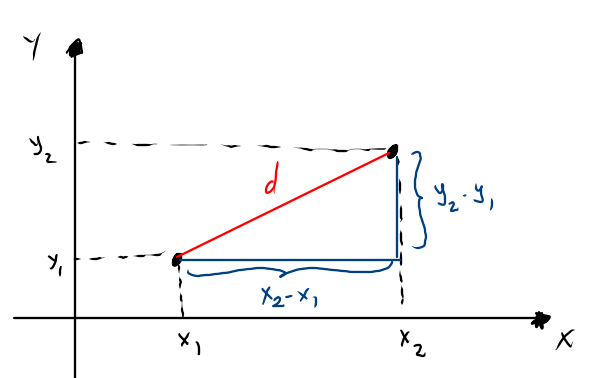
Thus, the distance d between the two points will be
d= \sqrt{(x_2 - x_1)^2 + (y_2 - y_1)^2}
Graph Translation
Consider a function y(x) = x^2. If we graph this, it will look like what is shown in the figure
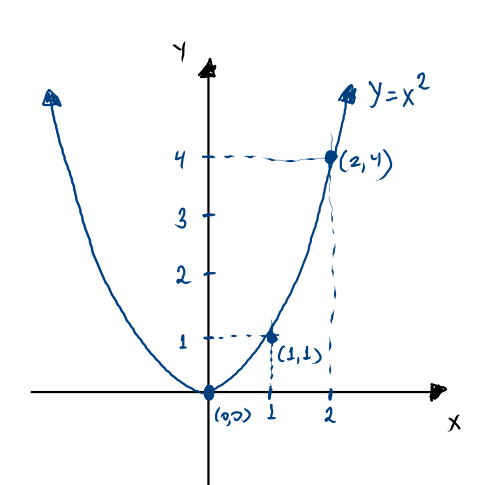
If in this function we replace x by x-1 and y by y-1,, we will then see the following transformation in the graph
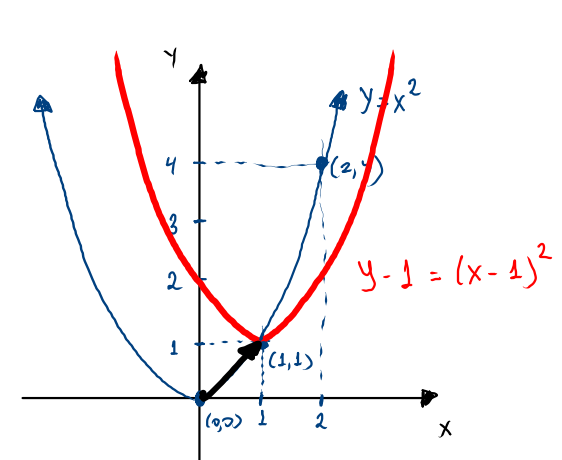
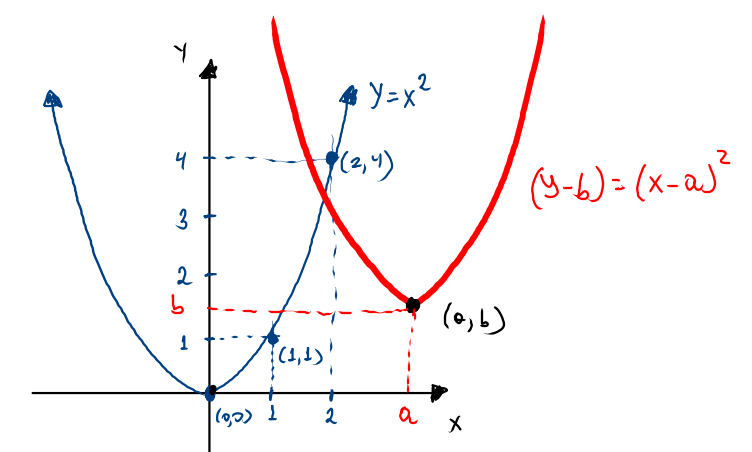
In general, each such replacement produces a translation transformation, namely
- x\longmapsto x-a: if a is positive, it moves a units to the right; if it is negative, it moves to the left.
- y\longmapsto y-b: if b is positive, it moves b units up; if negative, it moves down.
These are the translation transformations, and their general effect is summarized in the following figure
Definition of a Parabola
A parabola is the set of all points that are equidistant from a fixed point and a line.
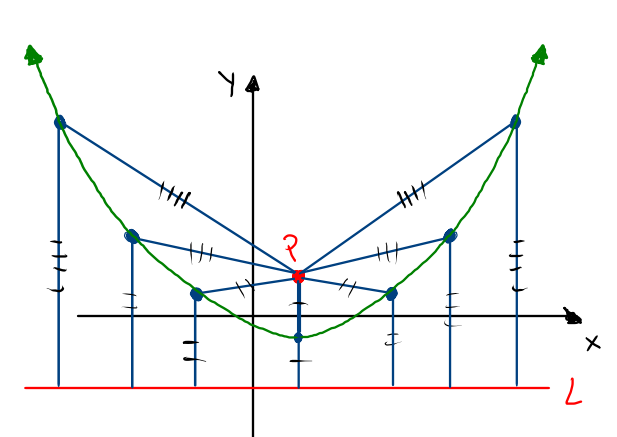
The fixed point is called the focus, and the line is the directrix. If we pay attention, we will see that the notion of distance is fundamental in defining parabolas, so to delve deeper into their analysis, it will be necessary to review how distances are measured in the Cartesian plane and how they are algebraically obtained.
Derivation of the Fundamental Equation of Parabolas
For simplicity, consider the focal point p_f= (0,f) and the directrix as the line L with the equation y=-p
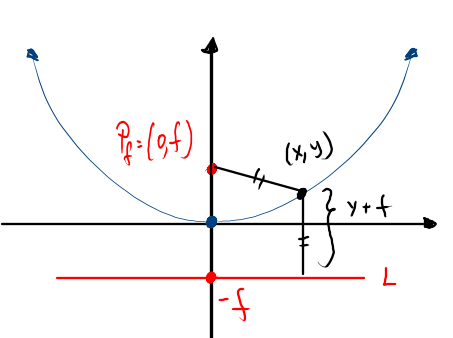
If we take any point on the parabola with coordinates (x,y), then it will be equidistant from both the focus and the directrix. This can be described algebraically as follows:
Distance Focus-Point(x,y) = \sqrt{x^2 + (f-y)^2}= y+f = Distance Point(x,y)-Directrix
And from this, the following reasoning develops:
| (1) | \sqrt{x^2 + (f-y)^2}= y+f | ; Distance point-focus = distance point-directrix, Def. of parabola |
| (2) | x^2 + (f-y)^2= (y+f)^2 | ; From (1), squaring both sides |
| x^2 + \cancel{f^2} - 2fy + \cancel{y^2}= \cancel{y^2} + 2fy + \cancel{f^2} | ||
| x^2 - 2fy = 2fy | ||
| \boxed{y=\dfrac{x^2}{4f}} |
This is what we call the Fundamental Equation of Parabolas.
If we pay attention to this parabola, we will notice that there is a point with the property of being closest to the focus (or equivalently to the directrix). This point is called the vertex, and for this particular case, it has coordinates (0,0); the distance between the focus and the vertex is called the focal distance, and its value f can be any real number except zero.
When f\gt 0, the parabola opens upwards, and conversely, when f\lt 0 , it opens downwards. As f\to 0, the parabola flattens, keeping the vertex in position and the directrix moves closer to the vertex, until the parabola and the directrix merge into a single line. When f=0, the graph disappears as divisions by zero do not exist.
The General Equation of Parabolas
From the fundamental equation of parabolas and graph translation, by substituting x\longmapsto (x-h) and y\longmapsto (y-k), we obtain the General Equation of Parabolas with a vertex at (h,k).
(y-k) = \dfrac{(x-h)^2}{4f}
Canonical Equation of Parabolas and Second-Degree Polynomials
If we expand the general equation of parabolas, the following reasoning arises:
| (1) | (y-k) = \dfrac{(x-h)^2}{4f} | ; General equation of parabolas |
| 4f(y-k) = (x-h)^2 | ||
| 4fy-4fk = x^2 - 2hx + h^2 | ||
| 4fy = x^2 - 2hx + h^2 + 4fk | ||
| y = \dfrac{1}{4f}x^2 - \dfrac{h}{2f}x + \dfrac{h^2 + 4fk}{4f} |
If we substitute a=\dfrac{1}{4f}, b=-\dfrac{2h}{4f}, and c=\dfrac{h^2 + 4fk}{4f},, then the general equation of parabolas transforms into the canonical equation, which turns out to be the quadratic polynomial.
\boxed{y=ax^2 + bx + c}