

Plane Mirrors, Solved Problems
Summary:
In this class, we will review some solved problems of plane mirrors. The angle of reflection \gamma is determined based on the angle \theta between two plane mirrors joined by a hinge, and specific examples are calculated. Critical values of \alpha are examined so that the ray bounces once on each mirror, and the formula for \gamma is validated. Additionally, angles of incidence are identified that cause the ray to return on itself, calculating a sequence of return angles \alpha_n = n\theta.
Learning Objectives
By the end of this class, the student will be able to:
- Understand the fundamental formulas of plane mirror optics.
- Apply the law of reflection in problems involving plane mirrors.
- Determine the angle of reflection \gamma based on the angle \theta between two plane mirrors.
- Analyze the limits of the formulas for mirrors and their validity conditions.
TABLE OF CONTENTS
Introduction
Mirrors Joined by a Hinge
Examining the Limits of Reasoning
Return Angles
Introduction
In the previous class, we reviewed most of the formulas related to the optics of plane and spherical mirrors; however, to achieve a better understanding of these topics, it is necessary to review how these appear in solving problems associated with these topics. Therefore, we will dedicate this part exclusively to reviewing the solution of some problems. This time we will focus exclusively on plane mirrors.
Mirrors Joined by a Hinge
Two plane mirrors joined by one end hold an angle \theta. If a light ray hits one of the mirrors at an angle \alpha relative to the normal so that the light bounces only once on each mirror and intersects itself forming an angle \gamma:
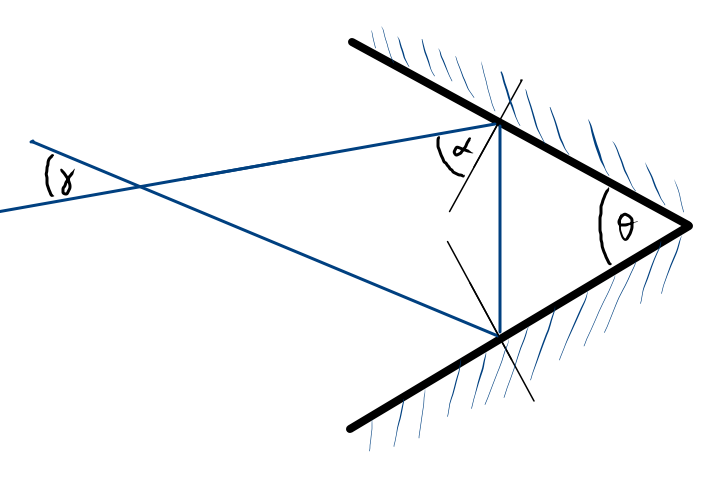
- Find a formula to determine the angle \gamma in terms of the other data.
- If the light ray hits the first mirror at an angle \alpha=30^o and the angle between the mirrors is \theta=50^o, what will the angle \gamma be?
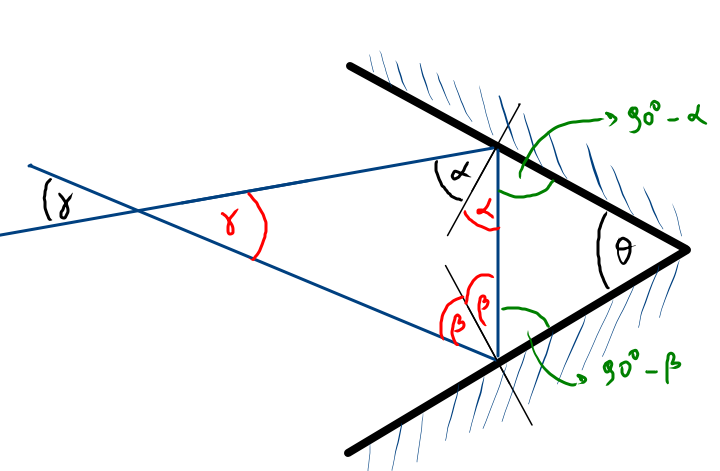
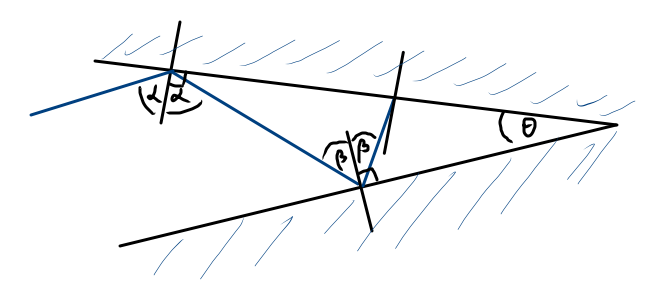
- Defining the angle \beta between the normal of the second mirror and the light ray reflected from the first mirror, and using the law of reflection in plane mirrors, we can complete the figure as follows:

With this in mind, it is now possible to perform the following reasoning:(1) (90^o - \alpha) + (90^o - \beta) + \theta = 180^o ; Because the sum of the interior angles of a triangle is 180^o \equiv \alpha + \beta = \theta (2) 2\alpha +2\beta + \gamma = 180 ; Because the sum of the interior angles of a triangle is 180^o \equiv \gamma = 180 - 2(\alpha + \beta) (3) \color{blue}{\gamma = 180 - 2\theta} ; From (1,2) Therefore, it is inferred that the angle \gamma will only be a function of the angle \theta formed by the mirrors, and its formula will be \gamma(\theta) = 180^0 - 2\theta
- Based on the reasoning in the previous part, we have that \gamma = 180^o - 2\cdot 50^o = 80^o
Examining the Limits of Reasoning
The previous exercise has a delicate problem. If you observe the statement, you will see that it requires that the light ray must only bounce once on each mirror; however, not any value of \alpha will serve for that to happen. Find the values of \alpha that satisfy such a condition and thus allow the formula obtained in the previous exercise to be valid.
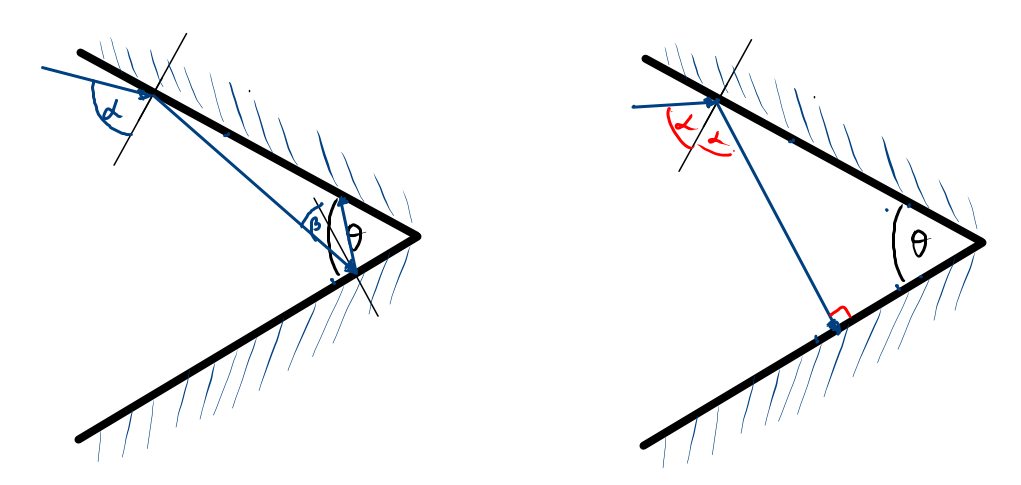
We have that \alpha reaches the “critical” value when it makes \beta=0^o; and when this happens, we can take an angle x that allows the following reasoning:
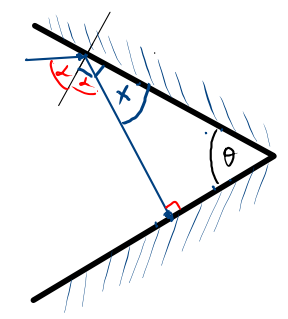
The following two equations must occur:
\alpha + x = 90^o
\theta + x = 90^o
And this is only possible if:
\alpha = \theta
That is to say: the value \alpha=\theta is the critical incidence angle such that if it is exceeded, then the ray will bounce more than twice on a mirror and, consequently, invalidate the formula obtained in the previous exercise. Based on these results, we can correct the result of the previous exercise by writing:
\gamma(\theta, \alpha) = 180^0 - 2\theta \;\;\;\; ; \;\;\;\; \alpha \in ]0,\theta[
Return Angles
From these results, we can see that, for certain incidence angles, the light ray returns on itself. This happens when \alpha = 0^o or when \alpha = \theta, where \theta is the angle formed between the two plane mirrors. Are there more return angles?; and if there are, how can they be calculated?
SOLUTIONTo solve this problem, we must imagine the situation that occurs when the light ray hits the first mirror at an angle relative to the normal \alpha\in ]\theta, 180^o[. When this happens, we have a situation like the one shown in the following figure:
Since the sum of the interior angles of a triangle is 180^o:
(90^o - \alpha) + (90^o + \beta) + \theta = 180
Simplifying this relationship, we can obtain the angle \beta in terms of \alpha and \theta.
\beta=\alpha - \theta
This expression is important because if \beta=\theta, then by the reasoning of the previous exercise, the ray should return on itself in the next reflection. Thus \alpha=2\theta. Therefore, this reasoning can be extended inductively through:
- \alpha_0 = 0^o
- \alpha_1 = \theta
- \alpha_{n-1} = \alpha_n - \theta
And from this, we have the sequence of return angles:
- \alpha_0 = 0^o
- \alpha_1 = \theta
- \alpha_{2} = 2\theta
\vdots
- \alpha_{n} = n\theta
In addition, we must note that both the angle between the plane mirrors and each incidence angle must be acute.