

Reflection in Plane and Spherical Mirrors
Abstract:
In this class, we will review the basic principles of geometric optics, focusing on reflection in plane and spherical mirrors. It defines key terms such as light ray, point object, and point image. Additionally, it addresses the sign convention for mirrors and Descartes’ law for calculating the position of images. The characteristics of concave and convex mirrors are also explored, and how they affect the formation of real and virtual images. Finally, the magnification factor is introduced to describe the change in the size and orientation of the image concerning the original object.
Learning Objectives
By the end of the class, the student will be able to:
- Understand geometric optics as a simplification of electromagnetic optics that facilitates the understanding of image formation through the use of geometry and calculus.
- Understand the laws of reflection and refraction and their application in image formation with mirrors and lenses.
- Comprehend and differentiate key concepts such as light ray, projected ray, point object, and point image.
- Apply the sign convention for mirrors to determine the position of objects and images.
- Analyze image formation in plane mirrors, highlighting the symmetry and virtual nature of the images.
Table of Contents
Basic Ideas in Geometric Optics
Definitions
Sign Convention for Mirrors
Plane Mirrors and Specular Reflection
Point Object in Front of a Plane Mirror
Extended Object in Front of a Plane Mirror
Reflection in Spherical Mirrors
Relationship Between the Object and Image Position in a Spherical Mirror
Limit Case When s\to +\infty
Reflection of Extended Objects in Spherical Mirrors
Concave and Convex Mirrors
The Magnification Factor and Its Interpretation
Basic Ideas in Geometric Optics
Geometric optics is a simplification of electromagnetic optics that allows for an easy understanding of image formation and its characteristics. Through Geometry and Calculus, it is possible to infer the laws of refraction and reflection that allow understanding the formation of images with mirrors and lenses. In this first installment, we will study the basic concepts of geometric optics and reflection in plane and spherical mirrors.
To begin addressing these ideas and make inferences, we will define some key concepts:
Definitions
| Light Ray | An imaginary line representing the path of light propagation. If the source is a point object, then the light emerges from it in the form of spherical (electromagnetic) waves; thus, light rays follow the direction of the energy flow or, if preferred, the direction of the Poynting vector. |
| Projected Ray | An imaginary line representing the extension of a light ray. |
| Point Object or Point Source | A point in space from which light rays originate, whether their own or reflected. The object can be point-like or extended; if it is point-like, it has no shape, only position; if extended, it has a finite, non-zero volume and a surrounding surface. |
| Point Image | The point in space where light rays or projected rays converge. |
| Reflection | The process by which light rays change direction upon striking a reflective surface. |
| Refraction | The process by which light rays change direction and speed when passing from one medium to another. |
Sign Convention for Mirrors
A useful concept for systematizing geometric optics is the sign convention for mirrors, introduced below:
- Object Position: If the object is on the side where light arrives at the reflecting surface, the magnitude associated with its position s is positive, and negative otherwise.
- Image Position: If the image is on the same side as the reflected light, the magnitude associated with its position s^\prime will be positive, and negative otherwise.
In a plane mirror, the equation s=-s^\prime. always holds.
Plane Mirrors and Specular Reflection
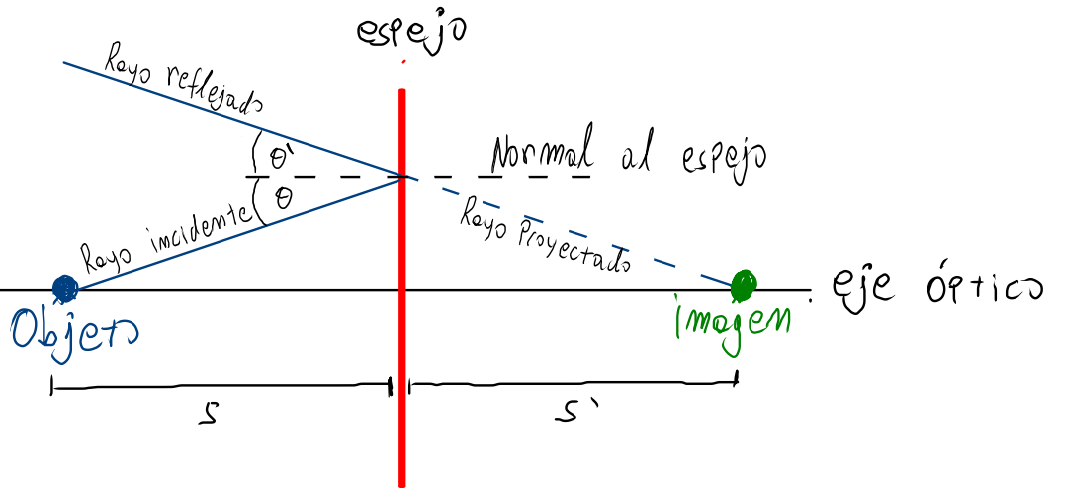
The simplest type of reflective surface is the plane mirror. In these, it is observed that every ray incident at an angle \theta with respect to the normal is reflected at an angle \theta^\prime =\theta. Consequently, an observer seeing the reflected ray will perceive it as if the reflected object were behind the mirror.
Point Object in Front of a Plane Mirror
The image formed in a plane mirror is symmetric and virtual. Symmetric means that the distance between the object and the mirror is the same as between the image and the mirror, and virtual means that the image is “behind the mirror.”
Extended Object in Front of a Plane Mirror
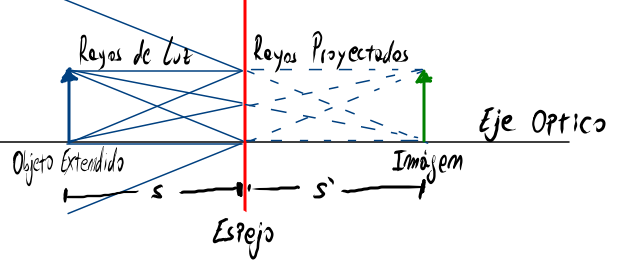
If an observer ignores the existence of the extended object and the mirror, upon receiving the reflected rays, they would interpret them as if they were coming from the image, as if the image were a real object.
Reflection in Spherical Mirrors
Relationship Between the Object and Image Position in a Spherical Mirror
Let’s consider a spherical mirror with a radius of curvature r. If we place an object at a distance s from the vertex, an image will appear at point s^\prime, as shown in the figure:
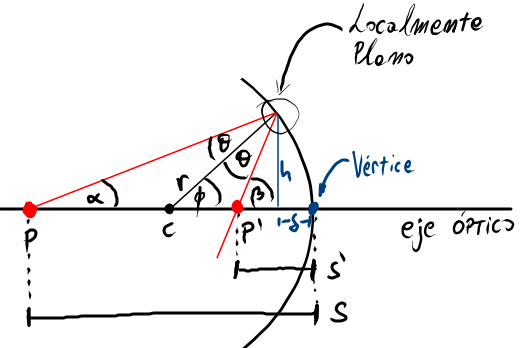
Since the sum of the interior angles of a triangle is \pi[rad], it follows that:
\begin{array}{lr} \phi + \theta + \pi - \beta =\pi\; &\Longrightarrow {\beta = \phi + \theta}\\ \\ \alpha + \theta + \pi - \phi =\pi\; &\Longrightarrow {\theta = \phi - \alpha} \end{array}
From this, it is inferred that \beta = 2\phi - \alpha and, therefore
\color{blue}{\alpha + \beta = 2\phi}.
With this information, it is possible to infer a relationship between the positions s and s^\prime of the object and the image, respectively. To do this, we observe that:
\begin{array}{rl} \tan(\alpha) &\displaystyle = \frac{h}{s - \delta} \\ \\ \tan(\beta) &\displaystyle = \frac{h}{s^\prime - \delta} \\ \\ \tan(\phi) &\displaystyle = \frac{h}{s - \delta} \end{array}
Now, if the object is far enough from the mirror, or the radius of curvature is large enough, it can be assumed that the angles \alpha, \beta and \phi are close to zero, and under this context, the approximations:
\begin{array}{rl} \delta & \approx 0 \\ \\ \alpha &\displaystyle \approx \tan(\alpha) \approx \frac{h}{s} \\ \\ \beta &\displaystyle \approx \tan(\beta) \approx \frac{h}{s^\prime} \\ \\ \phi &\displaystyle \approx \tan(\phi) \approx \frac{h}{r} \end{array}
Using these approximations on the equation highlighted in green, we obtain:
\displaystyle \frac{h}{s}+\frac{h}{s^\prime}\approx\frac{2h}{r}
Finally, simplifying h and replacing \displaystyle f = \frac{r}{2}, we get:
\displaystyle\color{blue}{\frac{1}{s}+\frac{1}{s^\prime}\approx\frac{1}{f}}
This is known as “Descartes’ law” for spherical mirrors with a small aperture, where the value f corresponds to the focal length of the lens.
Limit Case When s\to+\infty
If we calculate the value of s^\prime and take the limit as s\to+\infty, then we have:
\displaystyle s^\prime = \frac{1}{\frac{1}{f}-\frac{1}{s}} =\frac{sf}{s-f}
\displaystyle\lim_{s\to +\infty}s^\prime = \lim_{s\to +\infty}\frac{sf}{s-f}=f
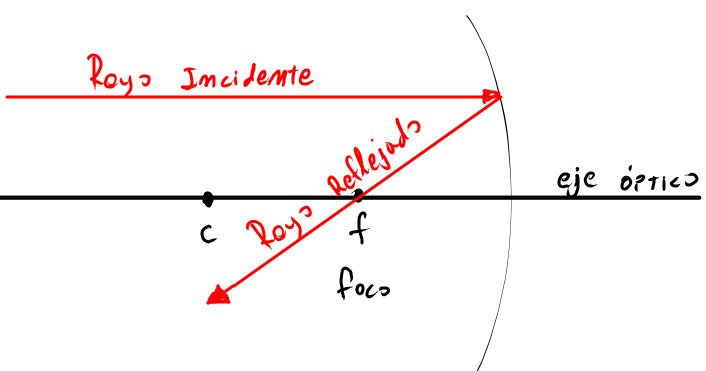
In other words, if we place the source very far away, then the ray that leaves it and reaches the mirror will follow an almost horizontal path, and upon reflecting off the mirror, it will pass through the focus as shown in the figure:
Reflection of Extended Objects in Spherical Mirrors
The results we have reviewed so far will allow us to geometrically find the location where the image of an object will be formed when the light it emits or reflects is reflected in a spherical mirror. To do this, simply note that all horizontal rays reflect through the focus, all rays passing through the focus reflect horizontally, and locally (at the point where the ray hits the spherical mirror), the mirror behaves like a plane mirror, so the angle of incidence will equal the reflected angle.
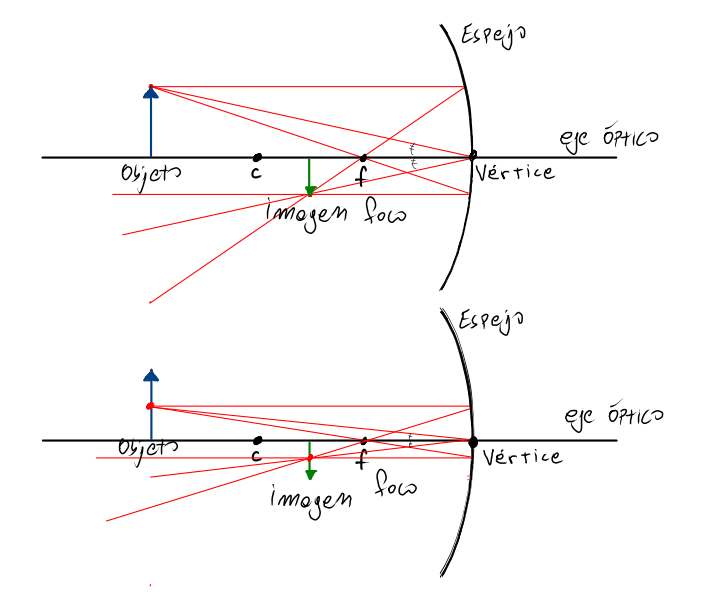
Each point of the extended object emits light rays that, after being reflected by the mirror, intersect at the corresponding point of the image.
Concave and Convex Mirrors
The spherical mirrors we have reviewed so far are all examples of concave mirrors. These are the ones where the curvature is on the side from which the light rays come. When the curvature is oriented towards the opposite side, it is said that the mirror is convex. When geometrically analyzing the formation of images in this type of mirror, the first thing noticed is that the reflected rays, instead of converging at a point, diverge; therefore, to find the location where the image is formed, it is necessary to project the reflected rays, thus obtaining a virtual image.
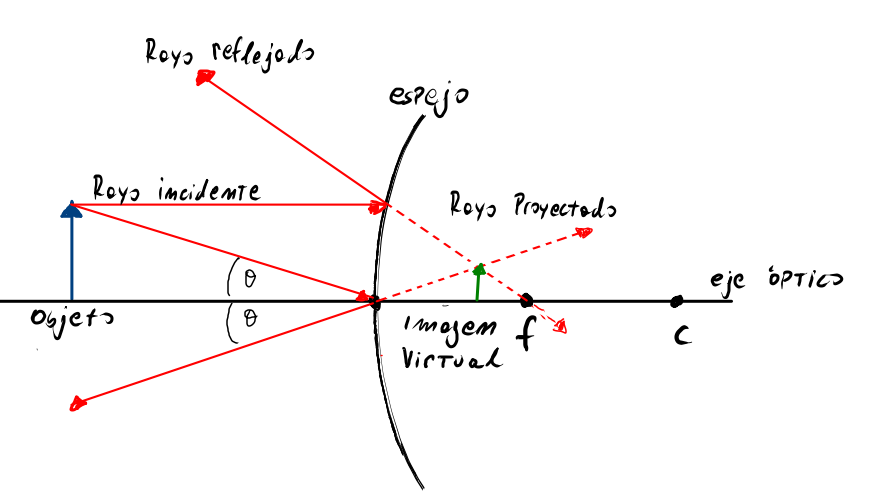
At this point, we must consider the following terms:
- Real Image: is when the image is formed by the reflected rays, and therefore is in front of the mirror.
- Virtual Image: is when the image is formed by the projected rays, and therefore “is behind the mirror.”
The Magnification Factor and Its Interpretation
As we have seen in the previous figures, when there is reflection in spherical, concave, or convex mirrors, the image can change in size or orientation compared to the original object. Then the question arises: Is there a way to model this magnification or reduction and change in the orientation of the image? The answer is yes, and it can be inferred from the similarity relationships of triangles in any of the figures we have reviewed. Below, the analysis for a concave mirror will be shown; for convex mirrors, the reasoning is analogous. To follow each step properly, keep in mind the sign conventions for mirrors we saw at the beginning.
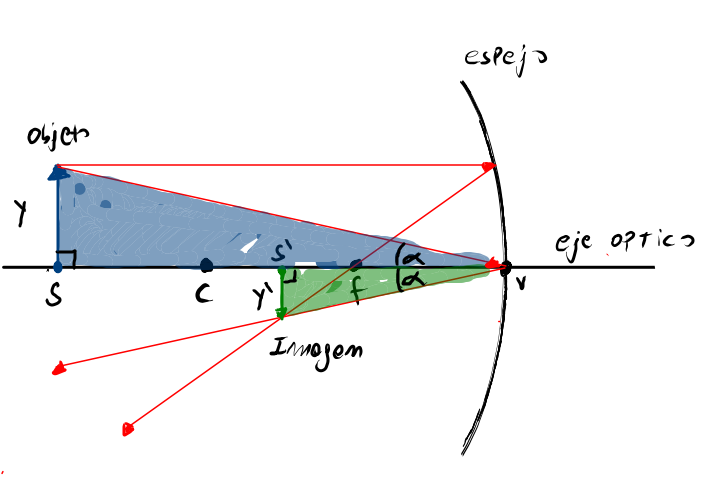
Since the blue and green triangles are similar, it follows that the magnification factor m=y^\prime/y, which tells us how much the reflected image enlarges compared to the original object’s size, can be calculated through the relation:
\displaystyle \frac{y}{s} = \frac{-y^\prime}{s^\prime}
Here, y^\prime is accompanied by a negative sign because the image is oriented downward (inverted), and by the sign convention for mirrors, s and s^\prime are both positive. Consequently, we have:
\displaystyle \color{blue}{m=\frac{y^\prime}{y} = - \frac{s^\prime}{s}}
That is, knowing the positions of the object and the image, it is possible to calculate the mirror’s magnification factor.
This formula can be composed with Descartes’ law to calculate the magnification factor from the focal length and the object’s position. Just remember that
\displaystyle s^\prime=\frac{sf}{s-f}.
and we have:
\displaystyle \color{blue}{m= - \frac{1}{s}\frac{sf}{s-f} = \frac{f}{f-s}}
From this, we have:
- If |m|\lt 1, the image contracts; when |m|\gt 1, the image expands; and when |m|=1,, it preserves its size.
- If m\gt 0, the image maintains the orientation of the original object; and when m\lt 0, the image inverts compared to the original object.
- The image reduces to a point when m=0.