

Equation of Hyperbolas and Its Deduction
Summary:
In this lesson, we will explore the geometric definition of the hyperbola, contrast it with the ellipse, and deduce its general and canonical equations.
Learning Objectives:
At the end of this lesson, the student will be able to:
- Define geometrically what a hyperbola is.
- Deduce the general and canonical equations of hyperbolas based on their geometric definition.
- Identify the differences between ellipses and hyperbolas in terms of focal distances.
CONTENT INDEX
Geometric Definition of Hyperbola
Deduction of the Equation of Hyperbolas
General Equation of Hyperbolas
Canonical Equation of Hyperbolas
Geometric Definition of Hyperbola
Previously, we reviewed the equation of ellipses and circles and discovered that they take the form ax^2 + bx + cy^2 + dy + e = 0, where a and b are two nonzero quantities with the same sign. We mentioned that if a and b have opposite signs, then instead of an ellipse, we would have a hyperbola. We said nothing more about these curves, and now we will fill that gap. We will complete our study by defining what a hyperbola is geometrically, and from this, we will obtain the general and canonical equations of hyperbolas.
On the one hand, we have that an ellipse is defined as the set of all points such that the sum of their distances from two other points, called foci, is always the same value. Similarly, and in contrast, a hyperbola is defined as the collection of all points such that the absolute value of the difference between their distances from the focal points is always the same value.
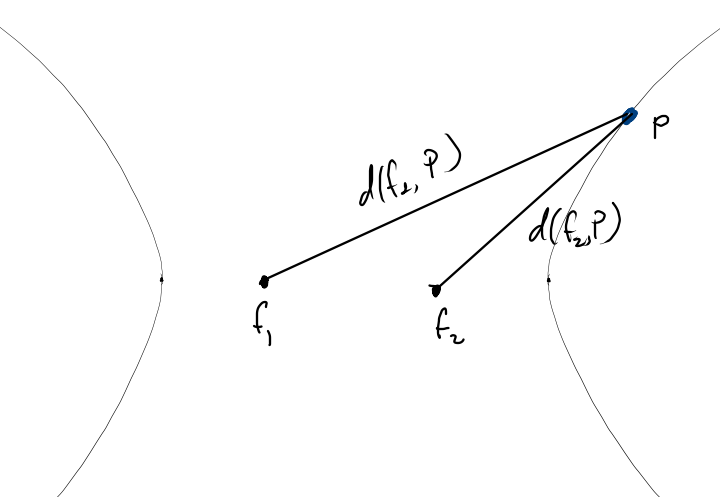
In other words, the relationship
|d(f_1,P) - d(f_2,P)| = 2a
is satisfied, where a is any fixed real number.
This actually produces two equations, namely: d(f_1,P) - d(f_2,P) = 2a and d(f_2,P) - d(f_1,P) = 2a, one for each branch of the hyperbola.
Deduction of the Equation of Hyperbolas
From the geometric definition, it is possible to obtain the algebraic representation of hyperbolas. To do this, we will start from the simplest case, and from there, we will extend the generalizations. Our reasoning will be carried out for one branch of the hyperbola; the reasoning for the other branch is completely analogous.
Deduction of the Simplified Form
Consider two focal points f_1 = (-c,0) and f_2 = (c,0). The point p = (x,y) will be on the hyperbola if
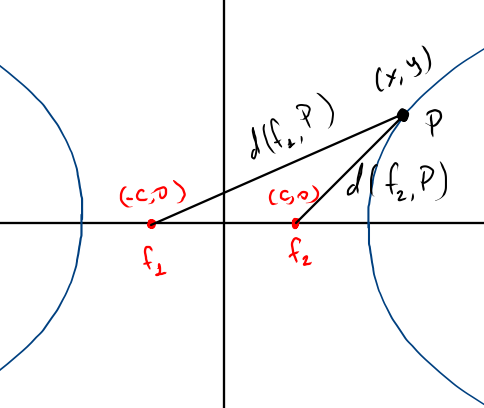
\sqrt{(x+c)^2+y^2} - \sqrt{(x-c)^2+y^2} = 2a
From here, the following reasoning follows:
| \sqrt{(x+c)^2+y^2} - \sqrt{(x-c)^2+y^2} = 2a | ; equation of the hyperbolas |
| \sqrt{x^2 + 2xc + c^2 + y^2} - \sqrt{x^2 - 2xc + c^2 + y^2} = 2a | ; expanding the squares |
| \sqrt{x^2 + 2xc + c^2 + y^2} = 2a + \sqrt{x^2 - 2xc + c^2 + y^2} | ; redistributing terms |
| \color{red}{x^2} + 2xc + \color{purple}{c^2} + \color{violet}{y^2} = 4a^2 + 4a\sqrt{x^2 - 2xc + c^2 + y^2} + \color{red}{x^2} - 2xc + \color{purple}{c^2} + \color{violet}{y^2} | ; squaring both sides |
| 2xc = 4a^2 + 4a\sqrt{x^2 - 2xc + c^2 + y^2} - 2xc | ; canceling like terms |
| 4xc = 4a^2 + 4a\sqrt{x^2 - 2xc + c^2 + y^2} | ; redistributing like terms |
| xc = a^2 + a\sqrt{x^2 - 2xc + c^2 + y^2} | ; simplifying like terms |
| xc - a^2 = a\sqrt{x^2 - 2xc + c^2 + y^2} | ; simplifying like terms |
| x^2c^2 -2xca^2 + a^4 = a^2(x^2 - 2xc + c^2 + y^2) | ; squaring both sides |
| x^2c^2 \color{red}{-2xca^2} + a^4 = a^2x^2 \color{red}{- 2xca^2} + a^2c^2 + a^2y^2 | ; operating parentheses |
| x^2c^2 + a^4 = a^2x^2 + a^2c^2 + a^2y^2 | ; canceling like terms |
| x^2(c^2 - a^2) - a^2y^2 = a^2c^2 - a^4 = a^2(c^2 - a^2) | ; regrouping terms |
| \displaystyle \frac{x^2}{a^2} - \frac{y^2}{c^2 - a^2} = 1 | ; regrouping terms |
For this final expression, as with ellipses, we take b^2=c^2-a^2 and arrive at the equation for ellipses:
\displaystyle \color{blue}{ \left(\frac{x}{a}\right)^2 - \left(\frac{y}{b}\right)^2 = 1 }
General Equation of Hyperbolas
To obtain the general equation of hyperbolas, we simply take the one we just obtained and apply the position transformations:
| x\longmapsto x-h |
| y\longmapsto y-k |
and with this, we automatically obtain the general equation of ellipses with center (h,k)
\displaystyle \color{blue}{ \left(\frac{x-h}{a}\right)^2 - \left(\frac{y-k}{b}\right)^2 = 1 }
Canonical Equation of Hyperbolas
And if we now take the general equation of ellipses and expand it, we arrive at the canonical expression:
| \displaystyle \left(\frac{x-h}{a}\right)^2 - \left(\frac{y-k}{b}\right)^2 = 1 | ; General equation of hyperbolas |
| b^2 (x^2 - 2xh + h^2) - a^2(y^2-2ky + y^2) = a^2b^2 | ; solving squares and multiplying everything by a^2b^2 |
| b^2 x^2 - 2hb^2x + h^2b^2 - a^2 y^2+ 2k a^2 y - a^2 k^2 = a^2b^2 | ; solving parentheses |
| b^2 x^2 - (2hb^2) x - a^2 y^2+ (2k a^2) y - (a^2b^2 + a^2 k^2 - h^2b^2) = 0 | ; Grouping like terms |
This last expression is of the form Ax^2+Bx + Cy^2 + Dy + E = 0, where A and C are always nonzero and have opposite signs, as we anticipated when studying ellipses.