

Limes Functionum Variabilis Realis
Summarium:
In hac lectione perscrutatur definicio formalis liminis functionum variabilis realis, ex qua demonstrantur proprietates praecipuae quae ad algebram limitum ducunt.
Proposita Discendi:
Post hanc lectionem discipulus poterit:
- Meminisse definitionem liminis functionum variabilis realis.
- Demonstrāre proprietates quae ad algebram limitum ducunt per deductiones \epsilon-\delta.
- Computāre limites functionum variabilis realis utens algebra limitum eiusque proprietatibus.
INDEX CONTENTORUM
Introductio
Notio Intuitiva Limiti Functionis ex Aspectu Graphico
Definitio Formalis Limiti
Proprietates Limitum
Si limes existit, tunc est unicus
Algebra Limitum
Computatio Limitum Simplicium
Introductio
Quid interest inter studium algebrae et geometriae respectu studii calculi?
Responsum ad hanc quaestionem nobis datur per notionem liminis. Hoc in articulo ergo studetur limes eiusque definitio.
Verbum “limes” plerumque connectitur cum quadam specie finis, sicut finis intervalli cuius termini sunt a, b (quaecumque eorum natura sit).
[a,b[\;\; ;\;\; ]a,b]\;\; ; \;\; ]a,b[\;\; ; [a,b]
Aut sicut praesens, de quo dici potest esse finis inter praeteritum et futurum. Similiter ac modo quodam, notio limitis inducit intellegentiam mathematicam huius notitiae intuitivae accessūs asymptotici ad punctum quendam.
Notio Intuitiva Limiti Functionis ex Aspectu Graphico
Ad ideam limitis percipiendam, oportet initium facere repraesentatione graphica functionis et quaerere quid eveniat cum f(x) dum x ad x_0 quantumvis appropinquat.
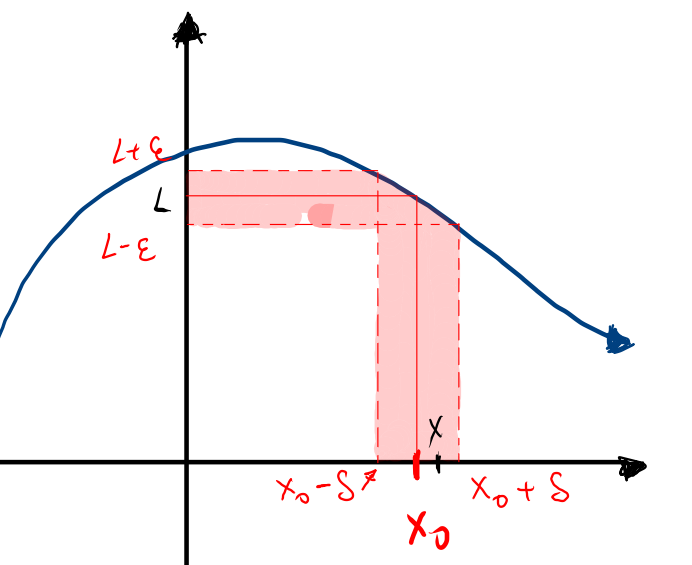
Si x est prope x_0, tunc exsistet intervallum apertum radii \delta et centrum x_0, ut x in eo contineatur. Hoc tripliciter exprimi potest:
|x-x_0|\lt \delta,
x\in]x_0 - \delta , x_0 + \delta[ ,
vel x\in\mathcal{B}(x_0,\delta)
In nostro contextu, hae sunt tres formae ad idem exprimendum; attamen illa postrema, quae legitur ut “x in sphaera aperta centro x_0 et radio \delta contentum esse”, aptior esset in cursu topologiae, ubi haec “notio propinquitatis” multo altius exploraretur.
Si hoc fit, tunc observabimus existere aliud intervallum apertum centro l et radio \epsilon tale ut f(x) in eo contineatur, id est: |f(x) - l|\lt \epsilon.
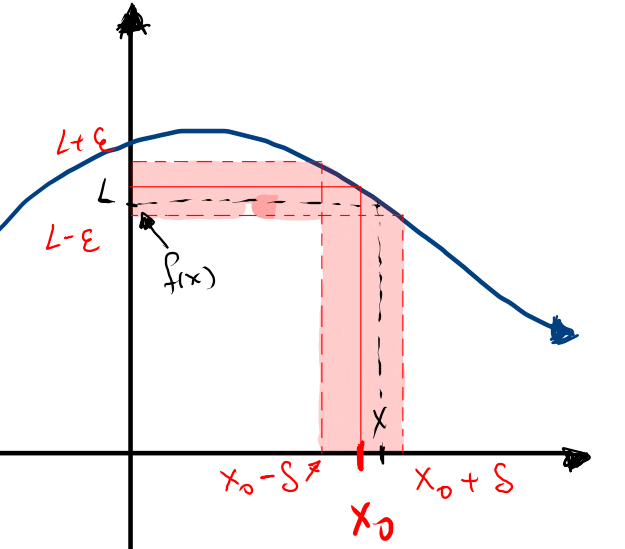
Hinc emergit idea fundamentalis notioni mathematicae limitis, ex eo quod hic exsistet cum: si 0 \lt|x-x_0|\lt \delta, tum |f(x)-l|\lt \epsilon; atque hoc valor l erit limes functionis cum x ad x_0 quantumlibet appropinquat.
Definitio Formalis Limiti
Ex notione intuitiva et graphica supra proposita incipere possumus ad definitionem formalem limitis explicandam. Dicimus limitem exsistere cum, quidquid sit hoc \epsilon (id est, distantia inter f(x) et l), semper exsistet \delta tale ut, si 0 \lt|x-x_0|\lt \delta satisfit, tunc etiam |f(x) - l|\lt \epsilon. Hoc principium, quod initio difficile est comprehendere et multis studentibus calculi lacrimas affert per orbem terrarum, compendiari potest hac formula:
\displaystyle \lim_{x\to x_0}f(x)=l := \left(\forall \epsilon \gt 0\right)\left(\exists \delta\gt 0\right) \left(0 \lt|x-x_0|\lt\delta \rightarrow |f(x) - l|\lt \epsilon\right)
Proprietates Limitum
Momentum definitionis formalis limitis est hoc: ex ea nunc possumus proprietates demonstrare, tum illas quae intuitive videntur verae tum etiam alias minus intuitivas.
Antequam pergamus, quamquam non est absolute necessarium, valde commendatur ut recognoscas aliquos conceptus logicae mathematicae, ut facilius intellegas demonstrationes quae infra sequuntur.
Si limes exsistit, tunc est unicus
Ad hanc proprietatem demonstrandam, adhibebimus rationem per absurdum. Incipiemus definientes sequentem collectionem praemissarum:
\displaystyle\mathcal{H}= \{\lim_{x\to x_0}f(x) = L, \lim_{x\to x_0}f(x) = L^\prime, L\neq L^\prime\}.
Ex hoc construere possumus sequentem probationem formalem:
| (1) | \displaystyle \mathcal{H}\vdash \lim_{x\to x_0}f(x) = L ; Praesumptio |
| \displaystyle \mathcal{H}\vdash \left(\forall \epsilon \gt 0\right)\left(\exists \delta\gt 0\right) \left(0 \lt|x-x_0|\lt\delta \rightarrow |f(x) - L|\lt \epsilon\right) | |
| (2) | \displaystyle \mathcal{H}\vdash \lim_{x\to x_0}f(x) = L^\prime ; Praesumptio |
| \displaystyle \mathcal{H}\vdash \left(\forall \epsilon \gt 0\right)\left(\exists \delta\gt 0\right) \left(0 \lt|x-x_0|\lt\delta \rightarrow |f(x) - L^\prime |\lt \epsilon\right) | |
| (3) | \displaystyle \mathcal{H}\vdash L \neq L^\prime ; Praesumptio |
| (4) | \displaystyle \mathcal{H}\vdash \left(\forall \epsilon \gt 0\right)\left(\exists \delta\gt 0\right) \left(0 \lt|x-x_0|\lt\delta \rightarrow\right. \left. \left[ \left( |f(x) - L |\lt \epsilon \right) \wedge \left( |f(x) - L^\prime |\lt \epsilon\right) \right] \right. ); \wedge–Intro(1,2) |
| (5) | \displaystyle \mathcal{H}\cup\{L\lt L^\prime\}\vdash \left(\forall \epsilon \gt 0\right)\left(\exists \delta\gt 0\right) \left(0 \lt|x-x_0|\lt\delta \rightarrow\right. \left. \left[ \left( |f(x) - L |\lt \epsilon \right) \wedge \left( |f(x) - L^\prime |\lt \epsilon\right) \right] \right. ); Monotonia(4) |
| (6) | \displaystyle \mathcal{H}\cup\{L\lt L^\prime\}\vdash \epsilon = \frac{L - L^\prime}{2}\gt 0 ; Quia L \lt L^\prime |
| (7) | \displaystyle \mathcal{H}\cup\{L\lt L^\prime\}\vdash \left(\exists \delta\gt 0\right) \left(0 \lt|x-x_0|\lt\delta \rightarrow\right. \left. \left[ \left( |f(x) - L |\lt \frac{L - L^\prime}{2} \right) \wedge \left( |f(x) - L^\prime |\lt \frac{L - L^\prime}{2}\right) \right] \right. ); Utendo(5,6) |
| \displaystyle \mathcal{H}\cup\{L\lt L^\prime\}\vdash (\exists \delta\gt 0) (0 \lt|x-x_0|\lt\delta \rightarrow [ ( 2 |f(x) - L |\lt L - L^\prime ) \wedge ( 2|f(x) - L^\prime |\lt L - L^\prime) ]) | |
| \displaystyle \mathcal{H}\cup\{L\lt L^\prime\}\vdash (\exists \delta\gt 0) (0 \lt|x-x_0|\lt\delta \rightarrow [ ( -L + L^\prime \lt 2 (f(x) - L )\lt L - L^\prime ) \wedge ( -L + L^\prime \lt 2(f(x) - L^\prime )\lt L - L^\prime) ]) | |
| \displaystyle \mathcal{H}\cup\{L\lt L^\prime\}\vdash (\exists \delta\gt 0) (0 \lt|x-x_0|\lt\delta \rightarrow [ ( -L + L^\prime \lt 2f(x) - 2L \lt L - L^\prime ) \wedge ( -L + L^\prime \lt 2f(x) - 2L^\prime \lt L - L^\prime) ]) | |
| \displaystyle \mathcal{H}\cup\{L\lt L^\prime\}\vdash (\exists \delta\gt 0) (0 \lt|x-x_0|\lt\delta \rightarrow [ ( L + L^\prime \lt 2f(x) \lt 3L - L^\prime ) \wedge ( -L + 3L^\prime \lt 2f(x) \lt L + L^\prime) ]) | |
| \displaystyle \mathcal{H}\cup\{L\lt L^\prime\}\vdash (\exists \delta\gt 0) (0 \lt|x-x_0|\lt\delta \rightarrow [ ( -L + 3L^\prime \lt 2f(x) \lt L + L^\prime) \wedge ( L + L^\prime \lt 2f(x) \lt 3L - L^\prime ) ]) | |
| (8) | \displaystyle \mathcal{H}\cup\{L\lt L^\prime\}\vdash \bot ; Ex(1,2,6,7) |
| (9) | \displaystyle \mathcal{H}\cup\{L\gt L^\prime\}\vdash \bot ; Eodem processu ac (8) |
| (10) | \displaystyle \mathcal{H}\vdash [(L\lt L^\prime) \vee (L\gt L^\prime)] \rightarrow \bot ; \vee-int(8,9) |
| (11) | \displaystyle \mathcal{H}\vdash [L\ \neq L^\prime] \rightarrow \bot ; Def(10) |
| (12) | \displaystyle \mathcal{H}\vdash \bot ; Modus Ponens(3,11) |
| \displaystyle \left\{\lim_{x\to x_0}f(x) = L, \lim_{x\to x_0}f(x) = L^\prime, L\neq L^\prime\right\} \vdash \bot | |
| (13) | \displaystyle \left\{\lim_{x\to x_0}f(x) = L, \lim_{x\to x_0}f(x) = L^\prime \right\} \vdash \neg(L\neq L^\prime) ; Contradictio(12) |
| \displaystyle \left\{\lim_{x\to x_0}f(x) = L, \lim_{x\to x_0}f(x) = L^\prime \right\} \vdash L = L^\prime. |
Ex hac demonstratione colligimus: si duo limites exsistunt, tunc sunt aequales, et ideo limes est unicus.
Algebra Limitum
Ex iis quae hactenus tractavimus, vidimus praecipua de notione mathematica limitis. Verumtamen hoc solum non sufficit ad limites computandos, nequaquam; solum insanus cruciatuum cupidus definitionem limitis ad hunc finem adhiberet. Ad hanc difficultatem solvendam, nunc tractabimus artes quae nos adiuvabunt ad quosdam limites computandos incipiendo.
Sint x_0, \alpha, \beta, L, M \in \mathbb{R}, et sint f et g functiones reales tales ut:
\displaystyle \lim_{x\to x_0} f(x) = L
\displaystyle \lim_{x\to x_0} g(x) = M
Tunc satisfiunt sequentia proprietates:
Limes Additionis et Differentiae Functionum
\displaystyle \lim_{x\to x_0} \left(\alpha f(x) \pm \beta g(x) \right) = \alpha L \pm \beta M
Demonstratio:
Consideremus collectionem praemissarum \displaystyle\mathcal{H}=\left\{\lim_{x\to x_0} f(x) = L, \lim_{x\to x_0} g(x) = M \right\}, ex qua possumus sequentem rationem construere:
| (1) | \displaystyle \mathcal{H}\vdash \lim_{x\to x_0}f(x) = L ; Praesumptio |
| \displaystyle \mathcal{H}\vdash \left(\forall \epsilon \gt 0 \right)\left(\exists \delta \gt 0 \right) \left(0 \lt |x-x_0|\lt \delta \rightarrow |f(x) - L|\lt \epsilon \right) | |
| \displaystyle \mathcal{H}\vdash \left(\forall \epsilon \gt 0 \right)\left(\exists \delta \gt 0 \right) \left(0 \lt |x-x_0|\lt \delta \rightarrow |\alpha||f(x) - L|\lt |\alpha|\epsilon \right) | |
| \displaystyle \mathcal{H}\vdash \left(\forall \epsilon \gt 0 \right)\left(\exists \delta \gt 0 \right) \left( 0 \lt|x-x_0|\lt \delta \rightarrow |\alpha f(x) - \alpha L|\lt |\alpha|\epsilon \right) | |
| (2) | \displaystyle \mathcal{H}\vdash \overline{\epsilon}:= |\alpha|\epsilon ; Def. |
| (3) | \displaystyle \mathcal{H}\vdash \left(\forall \overline{\epsilon} \gt 0 \right)\left(\exists \delta \gt 0 \right) \left(0 \lt |x-x_0|\lt \delta \rightarrow |\alpha f(x) - \alpha L|\lt \overline{\epsilon} \right) ; Ex(1,2) |
| \displaystyle \mathcal{H}\vdash \lim_{x\to x_0}\alpha f(x) = \alpha L | |
| (4) | \displaystyle \mathcal{H}\vdash \lim_{x\to x_0}g(x) = M ; Praesumptio |
| (5) | \displaystyle \mathcal{H}\vdash \lim_{x\to x_0}\beta g(x) = \beta M ; Analogia ad (3) |
| \displaystyle \mathcal{H}\vdash \left(\forall \overline{\overline{\epsilon}} \gt 0 \right)\left(\exists \delta \gt 0 \right) \left( 0 \lt |x-x_0|\lt \delta \rightarrow |\beta g(x) - \beta M|\lt \overline{\overline{\epsilon}} \right) | |
| (6) | \displaystyle \mathcal{H}\vdash \left(\forall \overline{\epsilon},\overline{\overline{\epsilon}} \gt 0 \right)\left(\exists \delta \gt 0 \right) \left(0 \lt |x-x_0|\lt \delta \rightarrow \left[|\alpha f(x) - \alpha L|+ |\beta g(x) - \beta M|\lt \overline{\epsilon}+ \overline{\overline{\epsilon}} \right] \right) ; Ex(3,5) |
| (7) | \displaystyle \mathcal{H}\vdash |\alpha f(x) - \alpha L + \beta g(x) - \beta M| \leq |\alpha f(x) - \alpha L|+ |\beta g(x) - \beta M| ; Inequalitas Triangularis: (\forall x,y\in\mathbb{R})(|x+y|\leq |x|+|y|) |
| (8) | \displaystyle \mathcal{H}\vdash \left(\forall \overline{\epsilon},\overline{\overline{\epsilon}} \gt 0 \right)\left(\exists \delta \gt 0 \right) \left(0 \lt |x-x_0|\lt \delta \rightarrow |\alpha f(x) - \alpha L + \beta g(x) - \beta M| \lt \overline{\epsilon}+ \overline{\overline{\epsilon}} \right) ; ex(6,7) |
| (9) | \epsilon^* := \overline{\epsilon} + \overline{\overline{\epsilon}}; Definitio |
| (10) | \displaystyle \mathcal{H}\vdash \left(\forall \epsilon^* \gt 0 \right)\left(\exists \delta \gt 0 \right) \left(0 \lt |x-x_0|\lt \delta \rightarrow |\alpha f(x) + \beta g(x) - \alpha L - \beta M| \lt \epsilon^* \right) ; ex(8,9) |
| \displaystyle \mathcal{H}\vdash \lim_{x\to x_0} (\alpha f(x) + \beta g(x)) = \alpha L + \beta M | |
| (11) | \gamma:= - \beta; Definitio |
| (12) | \displaystyle \mathcal{H}\vdash \lim_{x\to x_0} (\alpha f(x) + \gamma g(x)) = \alpha L + \gamma M ; Analogia(10) |
| (13) | \displaystyle \mathcal{H}\vdash \lim_{x\to x_0} (\alpha f(x) - \beta g(x)) = \alpha L - \beta M ; ex(11,12) |
| (14) | \displaystyle \mathcal{H}\vdash \lim_{x\to x_0} (\alpha f(x) \pm \beta g(x)) = \alpha L \pm \beta M ; ex(10,13) |
Limes Producti Functionum
\displaystyle \lim_{x\to x_0} \left( f(x) g(x) \right) = L M
Haec demonstratio paulo difficilior est quam praecedens, sed nihil est quod non possimus solvere per nonnullos dolos draconianos. Utentes eodem praemissarum systemate \mathcal{H} quo usi sumus in demonstratione praeterita, rationem sequentem construere possumus:
| (1) | \displaystyle \mathcal{H}\vdash \overline{\epsilon} := \frac{|\epsilon|}{2(|M|+1)} \leq \frac{|\epsilon|}{2} ; Definitio |
| (2) | \displaystyle \mathcal{H}\vdash \lim_{x\to x_0} f(x) = L ; Praesumptio |
| \displaystyle \mathcal{H}\vdash \left(\forall \overline{\epsilon} \gt 0 \right)\left(\exists \delta \gt 0 \right)\left(0 \lt |x-x_0|\lt \delta \rightarrow |f(x) - L| \lt \overline{\epsilon} = \frac{|\epsilon|}{2(|M|+1)}\right) ; Ex (1) | |
| (3) | \displaystyle \mathcal{H}\vdash \overline{\overline{\epsilon}} := \frac{|\epsilon|}{2(|L|+1)} \leq \frac{|\epsilon|}{2}; Definitio |
| (4) | \displaystyle \mathcal{H}\vdash \lim_{x\to x_0} g(x) = M ; Praesumptio |
| \displaystyle \mathcal{H}\vdash \left(\forall \overline{\overline{\epsilon}} \gt 0 \right)\left(\exists \delta \gt 0 \right)\left(0 \lt |x-x_0|\lt \delta \rightarrow |g(x) - M| \lt \overline{\overline{\epsilon}} = \frac{|\epsilon|}{2(|L|+1)}\right) ; Ex (3) | |
| (5) | \displaystyle \mathcal{H}\vdash |f(x)| - |L| \lt |f(x) - L| \lt \overline{\epsilon} \lt 1 ; Inequalitas Triangularis + Casus specialis \overline{\epsilon} |
| (6) | \displaystyle \mathcal{H}\vdash |f(x)|\lt 1 + |L| ; Ex (5) |
| (7) | \displaystyle \mathcal{H}\vdash |g(x)| - |M| \lt |g(x) - M| \lt \overline{\overline{\epsilon}} \lt 1 ; Inequalitas Triangularis + Casus specialis \overline{\overline{\epsilon}} |
| (8) | \displaystyle \mathcal{H}\vdash |g(x)| \lt 1 + |M| ; Ex (7) |
| (9) | \displaystyle \mathcal{H}\vdash |f(x)g(x) - LM|=| f(x)g(x) - Mf(x) + Mf(x) - LM |; Additio zeri |
| \displaystyle \mathcal{H}\vdash |f(x)g(x) - LM|=| f(x)(g(x) - M) + M (f(x) - L) |; Factorisatio | |
| (10) | \displaystyle \mathcal{H}\vdash |f(x)g(x) - LM|\leq | f(x)(g(x) - M) | + | M (f(x) - L) |; Inequalitas Triangularis (9) |
| \displaystyle \mathcal{H}\vdash |f(x)g(x) - LM|\leq |f(x)||g(x) - M| + |M| |f(x) - L| | |
| (11) | \displaystyle \mathcal{H}\vdash |f(x)g(x) - LM|\lt (1 + |L|)|g(x) - M| + |M|\overline{\epsilon}; Ex (5,6,10) |
| (12) | \displaystyle \mathcal{H}\vdash \left[ |g(x) - M|\lt \overline{\overline{\epsilon}} \right] \rightarrow \left[ (1+|L|)|g(x) - M| + |M|\overline{\epsilon} \lt (1+|L|)\overline{\overline{\epsilon}} + |M|\overline{\epsilon}\right]; Ex (11) |
| (13) | \displaystyle \mathcal{H}\vdash \left[ |g(x) - M|\lt \overline{\overline{\epsilon}} \right] \rightarrow \left[ (1+|L|)|g(x) - M| + |M|\overline{\epsilon} \lt (1+|L|)\frac{|\epsilon|}{2(|L|+1)} + |M|\frac{|\epsilon|}{2(|M|+1)}\right]; Ex(1,3,12) |
| \displaystyle \mathcal{H}\vdash \left[ |g(x) - M|\lt \overline{\overline{\epsilon}} \right] \rightarrow \left[ (1+|L|)|g(x) - M| + |M|\overline{\epsilon} \lt \frac{|\epsilon|}{2} + \frac{|\epsilon||M|}{2(|M|+1)} \lt \frac{|\epsilon|}{2}+ \frac{|\epsilon|}{2} = |\epsilon| \right] | |
| (14) | \displaystyle \mathcal{H}\vdash \left[ |g(x) - M|\lt \overline{\overline{\epsilon}} \right] \rightarrow \left[ |f(x)g(x) - LM|\lt |\epsilon| \right]; Ex(11,13) |
| (15) | \displaystyle \mathcal{H}\vdash (\forall \epsilon \gt 0 ) (\exists \delta \gt 0 ) \left(0 \lt |x-x_0|\lt \delta \rightarrow |f(x)g(x) - LM|\lt |\epsilon| \leq \epsilon \right) ; Ex(1,2,4,14) |
| \displaystyle \mathcal{H}\vdash \lim_{x\to x_0}f(x)g(x) = LM. |
Limes Functionis Constantis
Limes functionis constantis f(x)=c, est ipsa constans c. Id est:
\displaystyle \lim_{x\to x_0}c = c
Demonstratio
Haec demonstratio revera simplex est, cum sit tautologia. Notum est enim quod:
\displaystyle \lim_{x\to x_0}c = c := (\forall\epsilon\gt 0) (\exists \delta \gt 0)(0\lt|x-x_0|\lt \delta \rightarrow |c-c|\lt \epsilon)
Sed constat 0=|c-c|\lt \epsilon esse tautologiam pro omni epsilon positivo, unde etiam implicatio est tautologia, ac proinde expressio \displaystyle \lim_{x\to x_0}c = c est tautologia.
Limes Rationis Inter Functiones
Nunc parati sumus ad demonstrandum regulam limitis rationis inter duas functiones. Haec est:
\displaystyle \lim_{x\to x_0}\frac{f(x)}{g(x)}= \frac{L}{M}
Ubi, sicut in proprietatibus prioribus, praemissarum systema supponitur:
\displaystyle \mathcal{H}=\{\lim_{x\to x_0}f(x) = L, \lim_{x\to x_0}g(x) = M\}
Demonstratio
Fortunate, non amplius opus est demonstrationibus tam laboriosis, quia iam possumus directe uti praecedentibus resultatis. Sed antea demonstremus primum quod:
\displaystyle \lim_{x\to x_0}\frac{1}{g(x)} = \frac{1}{M}
Ad hoc probandum sufficit uti regula limitis producti una cum limite functionis constantis, modo caveamus ne g(x) sit nulla:
\displaystyle 1 = \lim_{x\to x_0}\left( 1 \right) \lim_{x\to x_0}\left( g(x) \cdot \frac{1}{g(x)} \right) = \lim_{x\to x_0}g(x) \cdot \lim_{x\to x_0} \frac{1}{g(x)} = M \cdot \lim_{x\to x_0} \frac{1}{g(x)}
Ergo: \displaystyle \lim_{x\to x_0} \frac{1}{g(x)} = \frac{1}{M}
Denique, per regulam limitis producti habemus:
\displaystyle \lim_{x\to x_0} \frac{f(x)}{g(x)} = \lim_{x\to x_0} f(x) \frac{1}{g(x)}= L \cdot\frac{1}{M} = \frac{L}{M}
Hoc valebit dummodo M non sit zero.
Limes Potentiae Naturalis
Haec proprietas nos docet quod, si \displaystyle \lim_{x_0 \to x_0}f(x) = L, tunc sequitur \displaystyle \left(\forall n \in \mathbb{N}\right) \left( \lim_{x\to x_0} \left( [f(x)]^n \right) = L^n \right). Hoc per inductionem mathematicam probari potest.
Demonstratio:
- Casus n=1: (basis inductionis)
\displaystyle \lim_{x\to x_0} [f(x)]^1 = \lim_{x\to x_0} f(x) = L. Quod demonstrat basim inductionis ✅
- Casus n=k: (passus inductivus)
Supponamus \displaystyle \lim_{x\to x_0} [f(x)]^k = L^k (Hypothesis Inductionis). Ostendemus tunc \displaystyle \lim_{x\to x_0} [f(x)]^{k+1} = L^{k+1} .
Habemus: \displaystyle \lim_{x\to x_0} [f(x)]^{k+1} = \lim_{x\to x_0} \{f(x) [f(x)]^k\} = \lim_{x\to x_0}f(x) \lim_{x\to x_0} [f(x)]^{k} =L \lim_{x\to x_0} [f(x)]^{k}. Hoc ex regula limitis producti, supra probata.
Ex hypothesi inductionis sequitur \displaystyle \lim_{x\to x_0} [f(x)]^{k+1} = L \lim_{x\to x_0} [f(x)]^{k} =L\cdot L^k = L^{k+1}. Quod complet passum inductivum ✅
- Ergo: \displaystyle \left(\forall n \in \mathbb{N}\right) \left( \lim_{x\to x_0} \left( [f(x)]^n \right) = L^n \right).
Limes Radicis n-ésimae
Similiter ac pro potentia habemus \displaystyle \left(\forall n \in \mathbb{N}\right) \left( \lim_{x\to x_0} \sqrt[n]{f(x)} = \sqrt[n]{L} \right)
Demonstratio:
Utentes regula potentiae, quam modo probavimus, habemus:
\displaystyle L= \lim_{x\to x_0} f(x)=\lim_{x\to x_0} \left[\sqrt[n]{f(x)}\right]^n = \left[ \lim_{x\to x_0} \sqrt[n]{f(x)}\right]^n
Ergo: \displaystyle \lim_{x\to x_0} \sqrt[n]{f(x)} =\sqrt[n]{L}.
Limes Potentiarum Fractionariarum
Cum virtutibus coniunctis duarum demonstrationum praecedentium concludere possumus ultimam nostram demonstrationem: \displaystyle \left(\forall p,q\neq 0 \in \mathbb{Z}\right) \left( \lim_{x\to x_0} \left[f(x)\right]^{\frac{p}{q}} = L^{\frac{p}{q}} \right). , quae oritur ex regula producti quia \displaystyle [f(x)]^{\frac{p}{q}} =[\sqrt[q]{f(x)}]^p et \displaystyle L^{\frac{p}{q}} =[\sqrt[q]{L}]^p.
Limes \displaystyle \lim_{x\to x_0}x = x_0
Hac hac demonstratione clausulam huic fluctui demonstrationum imponimus, quibus una cum superioribus possimus posthac multos limites fere intuitive computare.
Facile est probare \displaystyle \lim_{x\to x_0}x = x_0, quia ut hoc valeat, necesse est ut
(\forall \epsilon \gt 0) (\exists \delta \gt 0)(0\lt |x-x_0|\lt \delta\rightarrow |x-x_0|\lt \epsilon)
Secundum definitionem Limites, pro omni epsilon debet existere saltem unum delta quod caeteris positis satisfaciat; unde sufficit unum tale invenire ad comprobationem. Sed hoc revera manifestum est, quoniam satis est animadvertere quodlibet \delta\leq\epsilon talem condicionem satisfacere. Ergo: \displaystyle \lim_{x\to x_0}x = x_0.
Calculus limitum simplicium
Gratia omnium horum theorematum, quae modo pertractavimus, potest ampla limitum varietas modo satis intuitivo computari, ac si simpliciter functionem evaluaremus. Ecce nonnulla exempla:
- {}\\ \begin{array}{rl} \displaystyle \lim_{x\to 2}(x^2 + 4x) & = \displaystyle \lim_{x\to 2}(x^2) + \lim_{x\to 2}(4x) \\ \\ & = \displaystyle \left(\lim_{x\to 2} x \right)^2 + 4\lim_{x\to 2} x \\ \\ & = (2)^2 + 8 = 12 \end{array}
- {} \\ \begin{array}{rl} \displaystyle \lim_{x\to 1}\left.\frac{(3x-1)^2}{(x+1)^3} \right. & = \displaystyle \frac{(3(1)-1)^2}{((1)+1)^3} \\ \\ & = \displaystyle \frac{4}{8} = \frac{1}{2} \end{array}
- {} \\ \begin{array}{rl} \displaystyle \lim_{x\to 2} \frac{x-2}{x^2 - 4} &= \displaystyle \lim_{x\to 2} \frac{x-2}{(x-2)(x+2)} \\ \\ & = \displaystyle \lim_{x\to 2} \frac{1}{x+2} = \dfrac{1}{4} \end{array}
- {} \\ \begin{array}{rl} \displaystyle \lim_{h\to 0} \frac{(x+h)^3-x^3}{h} &= \displaystyle \lim_{h\to 0} \frac{x^3 + 3x^2 h + 3xh^2 -x^3}{h} \\ \\ & = \displaystyle\lim_{h\to 0} \frac{3x^2 h + 3xh^2}{h} \\ \\ & = \displaystyle \lim_{h\to 0} 3x^2 + 3xh = 3x^2 \end{array}
- {} \\ \begin{array}{rl} \displaystyle \lim_{x\to 1} \frac{x-1}{\sqrt{x^2 + 3} - 2 } &=\displaystyle \lim_{x\to 1} \frac{x-1}{\sqrt{x^2 + 3} - 2 } \frac{\sqrt{x^2 + 3} + 2}{\sqrt{x^2 + 3} + 2} \\ \\ & =\displaystyle \lim_{x\to 1} \frac{(x-1)(\sqrt{x^2 + 3} + 2)}{(x^2 + 3) - 4 } \\ \\ & =\displaystyle \lim_{x\to 1} \frac{(x-1)(\sqrt{x^2 + 3} + 2)}{x^2 -1 } \\ \\ & =\displaystyle \lim_{x\to 1} \frac{(x-1)(\sqrt{x^2 + 3} + 2)}{(x-1)(x+1) } \\ \\ & =\displaystyle \lim_{x\to 1} \frac{\sqrt{x^2 + 3} + 2}{ x+1 } \\ \\ & =\displaystyle \frac{2+2}{2} =2 \end{array}