The Refraction of Light and Snell’s Law
Summary:
In this class, we will explore the refraction of light through the analysis of Snell’s Law. The concept of the refractive index will be explained, Snell’s Law will be derived using Fermat’s principle, and the study of how this law allows us to calculate the path of a light ray as it passes through different media will be covered. Additionally, the phenomena of reflection and total reflection will be discussed, applying these concepts to a series of practical exercises. The goal is to understand and apply Snell’s Law in optical problems.
Learning Objectives
- Understand the concept of the refractive index and its relationship with the speed of light in different media.
- Apply Fermat’s principle to understand how light follows the path that minimizes the travel time between two points.
- Demonstrate Snell’s Law from Fermat’s principle to determine the path of a light ray passing through different media.
- Calculate the angles of incidence and refraction using Snell’s Law in situations with different refractive indices.
- Understand the concept of total internal reflection and how it relates to the critical angle and refractive indices.
- Determine the critical angle for total internal reflection at the interface between two media.
CONTENT INDEX
The Refractive Index
Fermat’s Principle
Snell’s Law of Light Refraction
Refraction, Reflection, and Total Reflection of Light
Exercises
The Refractive Index
The refractive index is defined of a medium as the ratio between the speed of light in a vacuum and the speed of light in that medium. This is a dimensionless quantity and is generally represented by the letter n_k:
n_k=\displaystyle \frac{c}{c_k}
Where c is the speed of light in a vacuum, and c_k is the speed of light in the medium k.
Since light always moves slower in any medium than in a vacuum, the refractive index is always greater than or equal to 1.
Fermat’s Principle
The speed of light depends on the medium in which it travels. The higher the refractive index of the medium, the slower the speed of light when traveling through it; and in relation to this, Fermat’s principle is stated:
When light travels from one point to another, it does so along the path that minimizes the travel time.
This principle holds even when light passes through different media.
Snell’s Law of Light Refraction
Based on what is established by Fermat’s principle, it is possible to formulate an optimization problem that will allow us to determine the path that a light ray will follow as it passes through different media. This is what ultimately leads to Snell’s Law, whose formulation and demonstration we will see below.
Suppose a ray departs from point A and arrives at point B, crossing an interface that separates two media with refractive indices n_1 and n_2 respectively. Our goal will be to find a relationship that allows us to calculate the path of the light ray following Fermat’s principle of minimum travel time, and for this, the following diagram is set up:
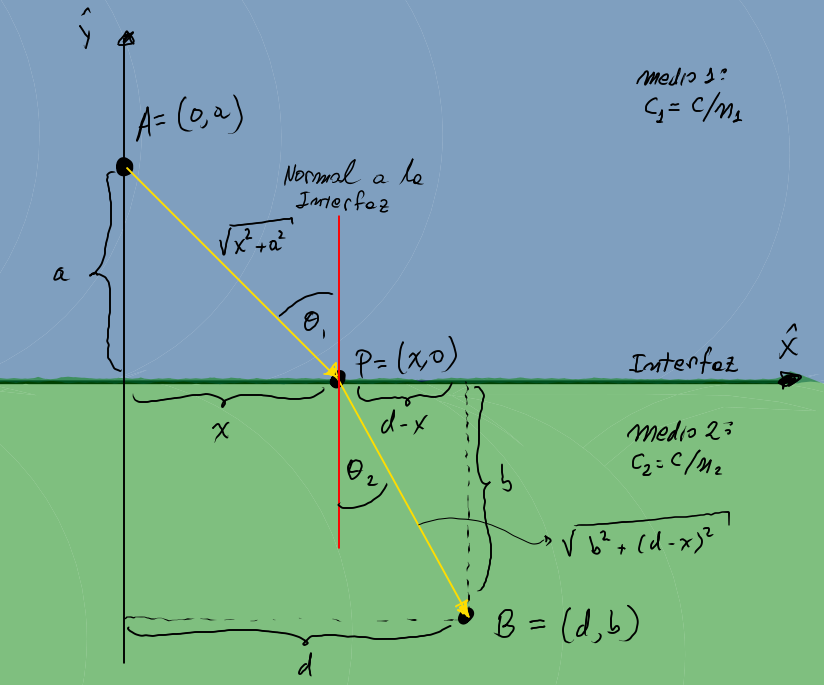
The reasoning begins by analyzing the form of the travel time of the light ray. We have:
\begin{array}{rl}{Travel\,Time} & =\displaystyle \frac{{Distance}}{{Speed}} \\ \\ & \displaystyle =\frac{{Distance\,in\,medium\,1}}{{Speed\,in\,medium\,1}} + \frac{{Distance\,in\,medium\,2}}{{Speed\,in\,medium\,2}}\\ \\& =\displaystyle \frac{\sqrt{a^2 + x^2}}{c_1} + \frac{\sqrt{b^2 + (d-x)^2}}{c_2}\end{array}
Having done this, keeping points A and B fixed, the travel time is determined by the point x at which the ray touches the interface between the media. With this, we can define a time function t(x) as
t(x) = \displaystyle \frac{1}{c_1}\sqrt{a^2 + x^2} + \frac{1}{c_2}\sqrt{b^2 + (d-x)^2}
Now, since Fermat’s principle states that light follows the path that minimizes travel time, it is possible from this to find the x that minimizes the function t(x). We are dealing with an optimization problem.
Differentiating t with respect to x, we have:
\displaystyle \begin{array}{rl}\dfrac{dt}{dx} &\displaystyle = \frac{1}{c_1}\frac{d}{dx}\sqrt{a^2 + x^2} + \frac{1}{c_2}\frac{d}{dx}\sqrt{b^2+(d-x)^2}\\ \\ &\displaystyle = \frac{1}{c_1} \frac{2x}{2\sqrt{a^2 + x^2}} + \frac{1}{c_2}\frac{2(d-x)(-1)}{2\sqrt{b^2+(d-x)^2}} \\ \\ &\displaystyle = \frac{1}{c_1} \frac{x}{\sqrt{a^2 + x^2}} - \frac{1}{c_2}\frac{(d-x)}{\sqrt{b^2+(d-x)^2}} \end{array}
Now notice that:
\begin{array}{rl}\sin(\theta_1) &\displaystyle =\frac{x}{\sqrt{a^2 + x^2}}\\ \\ \sin(\theta_2) &\displaystyle = \frac{(d-x)}{\sqrt{b^2+(d-x)^2}} \\ \\ c_1 & \displaystyle = \frac{c}{n_1} \\ \\ c_2 & \displaystyle = \frac{c}{n_2} \end{array}
So, replacing these in the time derivative, we have:
\displaystyle \frac{dt}{dx} = \frac{n_1}{c} \sin(\theta_1) - \frac{n_2}{c}\sin(\theta_2)
Finally, if point x minimizes the function t(x), then the derivative must be zero, and we have:
\color{blue}{n_1 \sin(\theta_1) = n_2 \sin(\theta_2)}
This is Snell’s Law for the refraction of a light ray passing between two media, showing the relationship between the angle of incidence \theta_1 and the refracted angle \theta_2.
Refraction, Reflection, and Total Reflection of Light
We have seen that when light passes from one medium to another, it refracts, but generally, what happens is a combination of refraction and reflection; and depending on the refractive indices and the angle of incidence of the light ray, refraction may disappear, leaving only reflection.
Suppose a light ray strikes from a material a to another b with refractive indices n_a and n_b respectively. If n_a \gt n_b, according to Snell’s Law, we have:
\displaystyle \sin(\theta_b) = \frac{n_a}{n_b}\sin(\theta_a)
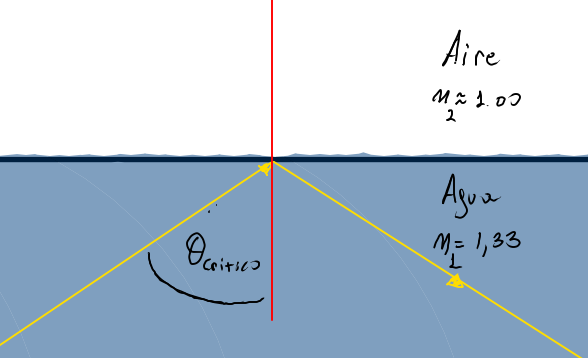
Since n_a/n_b \gt 1, it happens that \sin(\theta_b) \gt \sin(\theta_a), which implies that the refracted ray deviates away from the normal. This means that there must be some \theta_a\lt 90^o for which \sin(\theta_b)=1 and, therefore, \theta_b=90^o, as shown in the following figure.
The angle of incidence that causes the ray to refract along the interface is known as the critical angle and satisfies the relation:
\displaystyle \sin(\theta_{critical}) = \frac{n_b}{n_a}
Which is equivalent to saying:
\displaystyle \theta_{critical} = \arcsin\left( \frac{n_b}{n_a} \right)
If \theta_a \gt \theta_{critical}, then there is total reflection.
Exercises:
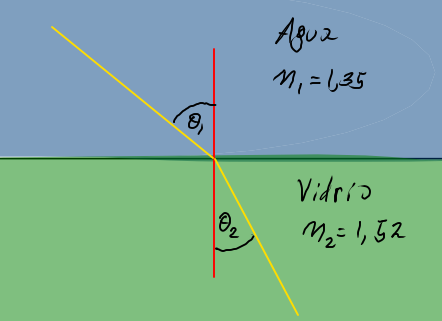
- Consider a light ray passing from water to glass as shown in the following figure:

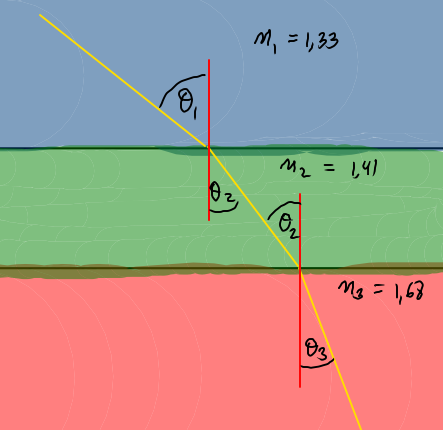
The refractive index of water is n_1 = 1.33, and that of glass is n_2=1.52. If a light ray passing from water to glass strikes the interface separating the two media with an inclination angle of \theta_1 = 60^o relative to the normal, at what angle \theta_2 does the refracted ray exit? SOLUTIONUsing Snell’s Law, we have:(1) n_1 \sin(\theta_1) = n_2 \sin(\theta_2) ; Snell’s Law \equiv \displaystyle \sin(\theta_2) = \frac{n_1}{n_2}\sin(\theta_1) \equiv \displaystyle \theta_2 = \arcsin\left(\frac{n_1}{n_2}\sin(\theta_1)\right) (2) n_1=1.33 ; Refractive index of water (3) n_2=1.52 ; Refractive index of glass (4) \theta_1=60^o ; Angle of incidence at the interface of the light ray (5) \displaystyle \theta_2 = \arcsin\left(\frac{1.33}{1.52}\sin(60^o)\right) \approx 49.268^o ; From (1,2,3,4), Refraction angle - Three liquids separated by two interfaces have the following refractive indices: n_1=1.33, n_2=1.41 and n_3=1.68, and are arranged as shown in the following figure:
(1) n_1 \sin(\theta_1) = n_2 \sin(\theta_2) ; Snell’s Law for the transition from medium n1 to n2 (2) n_2 \sin(\theta_2) = n_3 \sin(\theta_3) ; Snell’s Law for the transition from medium n2 to n3 (3) n_1 \sin(\theta_1) = n_3 \sin(\theta_3) ; From (1,2) \equiv \displaystyle \sin(\theta_3) = \frac{n_1}{n_3}\sin(\theta_1) \equiv \displaystyle \theta_3 = \arcsin\left(\frac{n_1}{n_3}\sin(\theta_1)\right) Finally, replacing the data, we have:
\displaystyle \theta_3= \arcsin\left(\frac{1.33}{1.68}\sin(70^o)\right) \approx 48.0667^o
Note that this reasoning shows that we can do the calculations by considering only the input and output media of the ray, completely ignoring the one in the middle. - From the bottom of a pool, a light ray is directed towards the interface between air and water. Determine the angle of incidence for total reflection to occur.
SOLUTIONThe critical angle will be given by:\displaystyle \theta_{critical}= \arcsin\left(\frac{1.00}{1.33}\right) \approx 48.7535^o