

一元实变量函数的极限
摘要:
本节课深入讨论了一元实变量函数的极限的正式定义,并在此基础上证明了极限代数的主要性质。
学习目标:
本节课结束时,学生将能够:
- 记住一元实变量函数的极限定义。
- 通过\epsilon-\delta推导证明导致极限代数的性质。
- 使用极限代数及其性质计算一元实变量函数的极限。
目录
介绍
从图形角度看函数极限的直观概念
极限的正式定义
极限的性质
如果极限存在,那么它是唯一的
极限代数
简单极限计算
介绍
代数和几何与微积分的学习有什么不同? 这个问题的答案由极限的概念给出。因此,本文章讨论了极限及其定义。
我们通常将“极限”一词与某种边界联系起来,就像有端点a和b的区间的边界(无论其性质如何)。
[a,b[\;\; ;\;\; ]a,b]\;\; ; \;\; ]a,b[\;\; ; [a,b] ,
或者像“现在”,我们可以说它是过去和未来的边界。类似地,极限的概念引入了对这一直观想法的数学理解,即渐近地接近某个点。
从图形角度看函数极限的直观概念
为了开始直观地理解极限的概念,最好从函数的图形表示入手,并询问当 f(x) 随 x 接近 x_0 时将会发生什么。
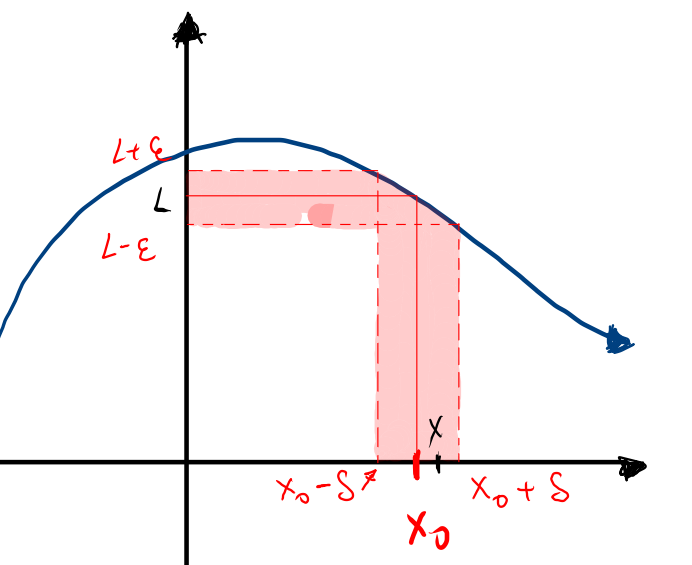
如果 x 接近 x_0,那么将存在以 x_0 为中心,半径为 \delta 的开区间,使得 x 包含在其中。我们可以用三种不同的方式来表示:
|x-x_0|\lt \delta,
|x\in]x_0 - \delta , x_0 + \delta[ ,
或者 x\in\mathcal{B}(x_0,\delta)
在我们的上下文中,这三种表示方式都是相同的;但最后一种,即“x 包含在以 x_0 为中心,半径为 \delta 的开球中”,更适合用于 拓扑学课程,在那里会对这个“邻近问题”进行更深入的探讨。
如果发生这种情况,那么我们将看到存在另一个以 l 为中心,半径为 \epsilon 的开区间,使得 f(x) 包含在其中,即:|f(x) - l|\lt \epsilon。
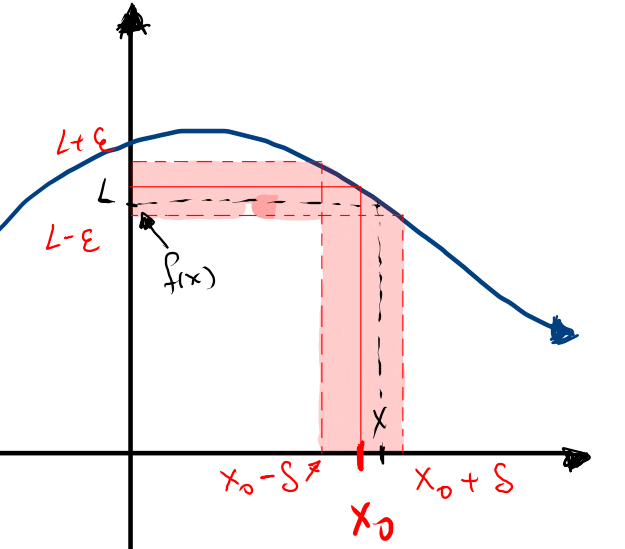
这里产生了极限概念的基本思想,即当 0 \lt|x-x_0|\lt \delta 时,如果 |f(x)-l|\lt \epsilon,则极限 l 存在。
极限的正式定义
从刚才呈现的直观和图形概念开始,可以推导出极限的正式定义。我们说极限存在,当且仅当无论 \epsilon 如何(即 f(x) 和 l 之间的距离),总能找到一个 \delta,使得当 0 \lt|x-x_0|\lt \delta 时,|f(x) - l|\lt \epsilon。这个概念可以通过以下表达式概括:
\displaystyle \lim_{x\to x_0}f(x)=l := \left(\forall \epsilon \gt 0\right)\left(\exists \delta\gt 0\right) \left(0 \lt|x-x_0|\lt\delta \rightarrow |f(x) - l|\lt \epsilon\right),
极限的性质
拥有极限的正式定义的好处在于,我们现在可以基于这个定义证明极限的各种性质,包括那些看似直观和不那么直观的性质。
在继续之前,虽然这不是严格必要的,但我们强烈建议你复习一些 数学逻辑 的概念,这样你会更容易理解接下来的证明。
如果极限存在,那么它是唯一的
为了证明这一性质,我们将使用反证法。首先定义以下假设集:
\displaystyle\mathcal{H}= \{\lim_{x\to x_0}f(x) = L, \lim_{x\to x_0}f(x) = L^\prime, L\neq L^\prime\}.
基于此,我们可以构建以下形式证明:
| (1) | \displaystyle \mathcal{H}\vdash \lim_{x\to x_0}f(x) = L ; 假设 |
| \displaystyle \mathcal{H}\vdash \left(\forall \epsilon \gt 0\right)\left(\exists \delta\gt 0\right) \left(0 \lt|x-x_0|\lt\delta \rightarrow |f(x) - L|\lt \epsilon\right) | |
| (2) | \displaystyle \mathcal{H}\vdash \lim_{x\to x_0}f(x) = L^\prime ; 假设 |
| \displaystyle \mathcal{H}\vdash \left(\forall \epsilon \gt 0\right)\left(\exists \delta\gt 0\right) \left(0 \lt|x-x_0|\lt\delta \rightarrow |f(x) - L^\prime |\lt \epsilon\right) | |
| (3) | \displaystyle \mathcal{H}\vdash L \neq L^\prime ; 假设 |
| (4) | \displaystyle \mathcal{H}\vdash \left(\forall \epsilon \gt 0\right)\left(\exists \delta\gt 0\right) \left(0 \lt|x-x_0|\lt\delta \rightarrow\right. \left. \left[ \left( |f(x) - L |\lt \epsilon \right) \wedge \left( |f(x) - L^\prime |\lt \epsilon\right) \right] \right. ); \wedge–合取(1,2) |
| (5) | \displaystyle \mathcal{H}\cup\{L\lt L^\prime\}\vdash \left(\forall \epsilon \gt 0\right)\left(\exists \delta\gt 0\right) \left(0 \lt|x-x_0|\lt\delta \rightarrow\right. \left. \left[ \left( |f(x) - L |\lt \epsilon \right) \wedge \left( |f(x) - L^\prime |\lt \epsilon\right) \right] \right. ); 单调性(4) |
| (6) | \displaystyle \mathcal{H}\cup\{L\lt L^\prime\}\vdash \epsilon = \frac{L - L^\prime}{2}\gt 0 ; 因为 L \lt L^\prime |
| (7) | \displaystyle \mathcal{H}\cup\{L\lt L^\prime\}\vdash \left(\exists \delta\gt 0\right) \left(0 \lt|x-x_0|\lt\delta \rightarrow\right. \left. \left[ \left( |f(x) - L |\lt \frac{L - L^\prime}{2} \right) \wedge \left( |f(x) - L^\prime |\lt \frac{L - L^\prime}{2}\right) \right] \right. ); 使用(5,6) |
| \displaystyle \mathcal{H}\cup\{L\lt L^\prime\}\vdash (\exists \delta\gt 0) (0 \lt|x-x_0|\lt\delta \rightarrow [ ( 2 |f(x) - L |\lt L - L^\prime ) \wedge ( 2|f(x) - L^\prime |\lt L - L^\prime) ]) | |
| \displaystyle \mathcal{H}\cup\{L\lt L^\prime\}\vdash (\exists \delta\gt 0) (0 \lt|x-x_0|\lt\delta \rightarrow [ ( -L + L^\prime \lt 2 (f(x) - L )\lt L - L^\prime ) \wedge ( -L + L^\prime \lt 2(f(x) - L^\prime )\lt L - L^\prime) ]) | |
| \displaystyle \mathcal{H}\cup\{L\lt L^\prime\}\vdash (\exists \delta\gt 0) (0 \lt|x-x_0|\lt\delta \rightarrow [ ( -L + L^\prime \lt 2f(x) - 2L \lt L - L^\prime ) \wedge ( -L + L^\prime \lt 2f(x) - 2L^\prime \lt L - L^\prime) ]) | |
| \displaystyle \mathcal{H}\cup\{L\lt L^\prime\}\vdash (\exists \delta\gt 0) (0 \lt|x-x_0|\lt\delta \rightarrow [ ( L + L^\prime \lt 2f(x) \lt 3L - L^\prime ) \wedge ( -L + 3L^\prime \lt 2f(x) \lt L + L^\prime) ]) | |
| \displaystyle \mathcal{H}\cup\{L\lt L^\prime\}\vdash (\exists \delta\gt 0) (0 \lt|x-x_0|\lt\delta \rightarrow [ ( -L + 3L^\prime \lt 2f(x) \lt L + L^\prime) \wedge ( L + L^\prime \lt 2f(x) \lt 3L - L^\prime ) ]) | |
| (8) | \displaystyle \mathcal{H}\cup\{L\lt L^\prime\}\vdash \bot ; 由(1,2,6,7) |
| (9) | \displaystyle \mathcal{H}\cup\{L\gt L^\prime\}\vdash \bot ; 同样的过程(8) |
| (10) | \displaystyle \mathcal{H}\vdash [(L\lt L^\prime) \vee (L\gt L^\prime)] \rightarrow \bot ; \vee-引入(8,9) |
| (11) | \displaystyle \mathcal{H}\vdash [L\ \neq L^\prime] \rightarrow \bot ; 定义(10) |
| (12) | \displaystyle \mathcal{H}\vdash \bot ; MP(3,11) |
| \displaystyle \left\{\lim_{x\to x_0}f(x) = L, \lim_{x\to x_0}f(x) = L^\prime, L\neq L^\prime\right\} \vdash \bot | |
| (13) | \displaystyle \left\{\lim_{x\to x_0}f(x) = L, \lim_{x\to x_0}f(x) = L^\prime \right\} \vdash \neg(L\neq L^\prime) ; 矛盾(12) |
| \displaystyle \left\{\lim_{x\to x_0}f(x) = L, \lim_{x\to x_0}f(x) = L^\prime \right\} \vdash L = L^\prime. |
通过此证明,我们得出,如果存在两个极限,则它们相等,因此极限是唯一的。
极限的代数
通过我们目前的学习,我们已经了解了极限的数学概念的基本思想。 但是仅仅依靠这些是远远不够的,要进行极限的计算,绝不会有人仅仅依靠极限的定义来进行计算。为了解决这个问题,我们将介绍一些技术,帮助我们开始计算一些极限。
设 x_0, \alpha, \beta, L, M \in \mathbb{R}, 以及 f 和 g 为实函数,并且满足:
\displaystyle \lim_{x\to x_0} f(x) = L
\displaystyle \lim_{x\to x_0} g(x) = M
那么,以下性质成立:
函数和与差的极限
\displaystyle \lim_{x\to x_0} \left(\alpha f(x) \pm \beta g(x) \right) = \alpha L \pm \beta M
证明:
考虑假设集 \displaystyle\mathcal{H}=\left\{\lim_{x\to x_0} f(x) = L, \lim_{x\to x_0} g(x) = M \right\},基于此我们可以进行以下推理:
| (1) | \displaystyle \mathcal{H}\vdash \lim_{x\to x_0}f(x) = L ; 假设 |
| \displaystyle \mathcal{H}\vdash \left(\forall \epsilon \gt 0 \right)\left(\exists \delta \gt 0 \right) \left(0 \lt |x-x_0|\lt \delta \rightarrow |f(x) - L|\lt \epsilon \right) | |
| \displaystyle \mathcal{H}\vdash \left(\forall \epsilon \gt 0 \right)\left(\exists \delta \gt 0 \right) \left(0 \lt |x-x_0|\lt \delta \rightarrow |\alpha||f(x) - L|\lt |\alpha|\epsilon \right) | |
| \displaystyle \mathcal{H}\vdash \left(\forall \epsilon \gt 0 \right)\left(\exists \delta \gt 0 \right) \left( 0 \lt|x-x_0|\lt \delta \rightarrow |\alpha f(x) - \alpha L|\lt |\alpha|\epsilon \right) | |
| (2) | \displaystyle \mathcal{H}\vdash \overline{\epsilon}:= |\alpha|\epsilon ; 定义 |
| (3) | \displaystyle \mathcal{H}\vdash \left(\forall \overline{\epsilon} \gt 0 \right)\left(\exists \delta \gt 0 \right) \left(0 \lt |x-x_0|\lt \delta \rightarrow |\alpha f(x) - \alpha L|\lt \overline{\epsilon} \right) ; 由(1,2) |
| \displaystyle \mathcal{H}\vdash \lim_{x\to x_0}\alpha f(x) = \alpha L | |
| (4) | \displaystyle \mathcal{H}\vdash \lim_{x\to x_0}g(x) = M ; 假设 |
| (5) | \displaystyle \mathcal{H}\vdash \lim_{x\to x_0}\beta g(x) = \beta M ; 与(3)类似 |
| \displaystyle \mathcal{H}\vdash \left(\forall \overline{\overline{\epsilon}} \gt 0 \right)\left(\exists \delta \gt 0 \right) \left( 0 \lt |x-x_0|\lt \delta \rightarrow |\beta g(x) - \beta M|\lt \overline{\overline{\epsilon}} \right) | |
| (6) | \displaystyle \mathcal{H}\vdash \left(\forall \overline{\epsilon},\overline{\overline{\epsilon}} \gt 0 \right)\left(\exists \delta \gt 0 \right) \left(0 \lt |x-x_0|\lt \delta \rightarrow \left[|\alpha f(x) - \alpha L|+ |\beta g(x) - \beta M|\lt \overline{\epsilon}+ \overline{\overline{\epsilon}} \right] \right) ; 由(3,5) |
| (7) | \displaystyle \mathcal{H}\vdash |\alpha f(x) - \alpha L + \beta g(x) - \beta M| \leq |\alpha f(x) - \alpha L|+ |\beta g(x) - \beta M| ; 三角不等式: (\forall x,y\in\mathbb{R})(|x+y|\leq |x|+|y|) |
| (8) | \displaystyle \mathcal{H}\vdash \left(\forall \overline{\epsilon},\overline{\overline{\epsilon}} \gt 0 \right)\left(\exists \delta \gt 0 \right) \left(0 \lt |x-x_0|\lt \delta \rightarrow |\alpha f(x) - \alpha L + \beta g(x) - \beta M| \lt \overline{\epsilon}+ \overline{\overline{\epsilon}} \right) ; 由(6,7) |
| (9) | \epsilon^* := \overline{\epsilon} + \overline{\overline{\epsilon}}; 定义 |
| (10) | \displaystyle \mathcal{H}\vdash \left(\forall \epsilon^* \gt 0 \right)\left(\exists \delta \gt 0 \right) \left(0 \lt |x-x_0|\lt \delta \rightarrow |\alpha f(x) + \beta g(x) - \alpha L - \beta M| \lt \epsilon^* \right) ; 由(8,9) |
| \displaystyle \mathcal{H}\vdash \lim_{x\to x_0} (\alpha f(x) + \beta g(x)) = \alpha L + \beta M | |
| (11) | \gamma:= - \beta; 定义 |
| (12) | \displaystyle \mathcal{H}\vdash \lim_{x\to x_0} (\alpha f(x) + \gamma g(x)) = \alpha L + \gamma M ; 类似(10) |
| (13) | \displaystyle \mathcal{H}\vdash \lim_{x\to x_0} (\alpha f(x) - \beta g(x)) = \alpha L - \beta M ; 由(11,12) |
| (14) | \displaystyle \mathcal{H}\vdash \lim_{x\to x_0} (\alpha f(x) \pm \beta g(x)) = \alpha L \pm \beta M ; 由(10,13) |
函数乘积的极限
\displaystyle \lim_{x\to x_0} \left( f(x) g(x) \right) = L M
这个证明比前一个稍微复杂一点, 但我们可以通过一些小技巧来解决这个问题。使用与前面证明相同的假设集 \mathcal{H},我们可以构建以下推理:
| (1) | \displaystyle \mathcal{H}\vdash \overline{\epsilon} := \frac{|\epsilon|}{2(|M|+1)} \leq \frac{|\epsilon|}{2} ; 定义 |
| (2) | \displaystyle \mathcal{H}\vdash \lim_{x\to x_0} f(x) = L ; 假设 |
| \displaystyle \mathcal{H}\vdash \left(\forall \overline{\epsilon} \gt 0 \right)\left(\exists \delta \gt 0 \right)\left(0 \lt |x-x_0|\lt \delta \rightarrow |f(x) - L| \lt \overline{\epsilon} = \frac{|\epsilon|}{2(|M|+1)}\right) ; 使用(1) | |
| (3) | \displaystyle \mathcal{H}\vdash \overline{\overline{\epsilon}} := \frac{|\epsilon|}{2(|L|+1)} \leq \frac{|\epsilon|}{2}; 定义 |
| (4) | \displaystyle \mathcal{H}\vdash \lim_{x\to x_0} g(x) = M ; 假设 |
| \displaystyle \mathcal{H}\vdash \left(\forall \overline{\overline{\epsilon}} \gt 0 \right)\left(\exists \delta \gt 0 \right)\left(0 \lt |x-x_0|\lt \delta \rightarrow |g(x) - M| \lt \overline{\overline{\epsilon}} = \frac{|\epsilon|}{2(|L|+1)}\right) ; 使用(3) | |
| (5) | \displaystyle \mathcal{H}\vdash |f(x)| - |L| \lt |f(x) - L| \lt \overline{\epsilon} \lt 1 ; 三角不等式 + 特殊情况 \overline{\epsilon} |
| (6) | \displaystyle \mathcal{H}\vdash |f(x)|\lt 1 + |L| ; 由(5) |
| (7) | \displaystyle \mathcal{H}\vdash |g(x)| - |M| \lt |g(x) - M| \lt \overline{\overline{\epsilon}} \lt 1 ; 三角不等式 + 特殊情况 \overline{\overline{\epsilon}} |
| (8) | \displaystyle \mathcal{H}\vdash |g(x)| \lt 1 + |M| ; 由(7) |
| (9) | \displaystyle \mathcal{H}\vdash |f(x)g(x) - LM|=| f(x)g(x) - Mf(x) + Mf(x) - LM |; 加零 |
| \displaystyle \mathcal{H}\vdash |f(x)g(x) - LM|=| f(x)(g(x) - M) + M (f(x) - L) |; 因式分解 | |
| (10) | \displaystyle \mathcal{H}\vdash |f(x)g(x) - LM|\leq | f(x)(g(x) - M)| + | M (f(x) - L) |; 三角不等式(9) |
| \displaystyle \mathcal{H}\vdash |f(x)g(x) - LM|\leq |f(x)||g(x) - M| + |M| |f(x) - L| | |
| (11) | \displaystyle \mathcal{H}\vdash |f(x)g(x) - LM|\lt (1 + |L|)|g(x) - M|+ |M|\overline{\epsilon}; 由(5,6,10) |
| (12) | \displaystyle \mathcal{H}\vdash \left[ |g(x) - M|\lt \overline{\overline{\epsilon}} \right] \rightarrow \left[ (1+|L|)|g(x) - M| + |M|\overline{\epsilon} \lt (1+|L|)\overline{\overline{\epsilon}} + |M|\overline{\epsilon}\right]; 由(11) |
| (13) | \displaystyle \mathcal{H}\vdash \left[ |g(x) - M|\lt \overline{\overline{\epsilon}} \right] \rightarrow \left[ (1+|L|)|g(x) - M| + |M|\overline{\epsilon} \lt (1+|L|)\frac{|\epsilon|}{2(|L|+1)} + |M|\frac{|\epsilon|}{2(|M|+1)}\right]; 由(1,3,12) |
| \displaystyle \mathcal{H}\vdash \left[ |g(x) - M|\lt \overline{\overline{\epsilon}} \right] \rightarrow \left[ (1+|L|)|g(x) - M| + |M|\overline{\epsilon} \lt \frac{|\epsilon|}{2} + \frac{|\epsilon||M|}{2(|M|+1)} \lt \frac{|\epsilon|}{2}+ \frac{|\epsilon|}{2} = |\epsilon| \right] | |
| (14) | \displaystyle \mathcal{H}\vdash \left[ |g(x) - M|\lt \overline{\overline{\epsilon}} \right] \rightarrow \left[ |f(x)g(x) - LM|\lt |\epsilon| \right]; 由(11,13) |
| (15) | \displaystyle \mathcal{H}\vdash (\forall \epsilon \gt 0 ) (\exists \delta \gt 0 ) \left(0 \lt |x-x_0|\lt \delta \rightarrow |f(x)g(x) - LM|\lt |\epsilon| \leq \epsilon \right) ; 由(1,2,4,14) |
| \displaystyle \mathcal{H}\vdash \lim_{x\to x_0}f(x)g(x) = LM. |
常数函数的极限
常数函数的极限 f(x)=c, 是常数 c。也就是说:
\displaystyle \lim_{x\to x_0}c = c
证明
这个证明其实很简单,因为它实际上是一个同义反复。我们已经知道:
\displaystyle \lim_{x\to x_0}c = c := (\forall\epsilon\gt 0) (\exists \delta \gt 0)(0\lt|x-x_0|\lt \delta \rightarrow |c-c|\lt \epsilon)
但实际上 0=|c-c|\lt \epsilon 对于任何正的 \epsilon 都是一个同义反复,因此整个表达式也是同义反复,结论是 \displaystyle \lim_{x\to x_0}c = c。
函数商的极限
\displaystyle \lim_{x\to x_0}\frac{f(x)}{g(x)}= \frac{L}{M}
与之前的性质类似,我们假设满足以下条件:
\displaystyle \mathcal{H}=\{\lim_{x\to x_0}f(x) = L, \lim_{x\to x_0}g(x) = M\}
证明
幸运的是,我们不需要再像之前一样做繁琐的证明,因为我们现在可以直接使用这些结果。但在此之前,首先证明:
\displaystyle \lim_{x\to x_0}\frac{1}{g(x)} = \frac{1}{M}
为了证明这一点,我们只需使用函数乘积的极限规则和常数函数的极限规则,并确保 g(x) 不为零:
\displaystyle 1 = \lim_{x\to x_0}\left( 1 \right) \lim_{x\to x_0}\left( g(x) \cdot \frac{1}{g(x)} \right) = \lim_{x\to x_0}g(x) \cdot \lim_{x\to x_0} \frac{1}{g(x)} = M \cdot \lim_{x\to x_0} \frac{1}{g(x)}
因此:\displaystyle \lim_{x\to x_0} \frac{1}{g(x)} = \frac{1}{M}
最终,根据函数乘积的极限规则,我们有:
\displaystyle \lim_{x\to x_0} \frac{f(x)}{g(x)} = \lim_{x\to x_0} f(x) \frac{1}{g(x)}= L \cdot\frac{1}{M} = \frac{L}{M}
这成立的前提是 M 不为零。
自然幂次的极限
这个性质告诉我们, 如果 \displaystyle \lim_{x_0 \to x_0}f(x) = L,那么将会有 \displaystyle \left(\forall n \in \mathbb{N}\right) \left( \lim_{x\to x_0} \left( [f(x)]^n \right) = L^n \right)。我们可以用数学归纳法证明这一点。
证明:
- 情况 n=1: (初始步骤)
\displaystyle \lim_{x\to x_0} [f(x)]^1 = \lim_{x\to x_0} f(x) = L. 这完成了初始步骤 ✅
- 情况 n=k: (归纳步骤)
假设:\displaystyle \lim_{x\to x_0} [f(x)]^k = L^k (归纳假设),我们接下来证明 \displaystyle \lim_{x\to x_0} [f(x)]^{k+1} = L^{k+1} 。
我们有:\displaystyle \lim_{x\to x_0} [f(x)]^{k+1} = \lim_{x\to x_0} \{f(x) [f(x)]^k\} = \lim_{x\to x_0}f(x) \lim_{x\to x_0} [f(x)]^{k} =L \lim_{x\to x_0} [f(x)]^{k}。这是基于前面已经证明的乘积极限规则。
然后,根据归纳假设,我们有 \displaystyle \lim_{x\to x_0} [f(x)]^{k+1} = L \lim_{x\to x_0} [f(x)]^{k} =L\cdot L^k = L^{k+1}. 这完成了归纳步骤 ✅
- 因此:\displaystyle \left(\forall n \in \mathbb{N}\right) \left( \lim_{x\to x_0} \left( [f(x)]^n \right) = L^n \right).
n次方根的极限
类似于幂次,我们有: \displaystyle \left(\forall n \in \mathbb{N}\right) \left( \lim_{x\to x_0} \sqrt[n]{f(x)} = \sqrt[n]{L} \right)
证明:
使用刚刚证明的幂次规则,我们有:
\displaystyle L= \lim_{x\to x_0} f(x)=\lim_{x\to x_0} \left[\sqrt[n]{f(x)}\right]^n = \left[ \lim_{x\to x_0} \sqrt[n]{f(x)}\right]^n
因此:\displaystyle \lim_{x\to x_0} \sqrt[n]{f(x)} =\sqrt[n]{L}.
分数幂次的极限
结合之前两个证明的力量 我们可以得出最后一个证明,即:\displaystyle \left(\forall p,q\neq 0 \in \mathbb{Z}\right) \left( \lim_{x\to x_0} \left[f(x)\right]^{\frac{p}{q}} = L^{\frac{p}{q}} \right). 这个结果是通过乘积规则得到的,因为 \displaystyle [f(x)]^{\frac{p}{q}} =[\sqrt[q]{f(x)}]^p 和 \displaystyle L^{\frac{p}{q}} =[\sqrt[q]{L}]^p.
极限 \displaystyle \lim_{x\to x_0}x = x_0
这个证明将结束这一系列的证明。 结合之前的证明,我们将能够直观地计算大量的极限。
证明 \displaystyle \lim_{x\to x_0}x = x_0 非常简单,因为要满足这个条件,需要:
(\forall \epsilon \gt 0) (\exists \delta \gt 0)(0\lt |x-x_0|\lt \delta\rightarrow |x-x_0|\lt \epsilon)
根据极限定义,对于任意 \epsilon,必须至少存在一个 \delta 使得其他条件成立;因此,只需找到这样一个 \delta 来验证极限的正确性。这实际上是显而易见的,因为任何 \delta\leq\epsilon 都满足此条件。因此:\displaystyle \lim_{x\to x_0}x = x_0.
简单极限的计算
感谢我们刚刚回顾的所有这些定理,因此我们可以通过相对直观的方式计算大量极限,就像我们只需对函数进行求值一样。这里你可以看到一些例子:
- {}\\ \begin{array}{rl} \displaystyle \lim_{x\to 2}(x^2 + 4x) & = \displaystyle \lim_{x\to 2}(x^2) + \lim_{x\to 2}(4x) \\ \\ & = \displaystyle \left(\lim_{x\to 2} x \right)^2 + 4\lim_{x\to 2} x \\ \\ & = (2)^2 + 8 = 12 \end{array}
- {} \\ \begin{array}{rl} \displaystyle \lim_{x\to 1}\left.\frac{(3x-1)^2}{(x+1)^3} \right. & = \displaystyle \frac{(3(1)-1)^2}{((1)+1)^3} \\ \\ & = \displaystyle \frac{4}{8} = \frac{1}{2} \end{array}
- {} \\ \begin{array}{rl} \displaystyle \lim_{x\to 2} \frac{x-2}{x^2 - 4} &= \displaystyle \lim_{x\to 2} \frac{x-2}{(x-2)(x+2)} \\ \\ & = \displaystyle \lim_{x\to 2} \frac{1}{x+2} = \dfrac{1}{4} \end{array}
- {} \\ \begin{array}{rl} \displaystyle \lim_{h\to 0} \frac{(x+h)^3-x^3}{h} &= \displaystyle \lim_{h\to 0} \frac{x^3 + 3x^2 h + 3xh^2 -x^3}{h} \\ \\ & = \displaystyle\lim_{h\to 0} \frac{3x^3 h + 3xh^2}{h} \\ \\ & = \displaystyle \lim_{h\to 0} 3x^2 + 3xh = 3x^2 \end{array}
- {} \\ \begin{array}{rl} \displaystyle \lim_{x\to 1} \frac{x-1}{\sqrt{x^2 + 3} - 2 } &=\displaystyle \lim_{x\to 1} \frac{x-1}{\sqrt{x^2 + 3} - 2 } \frac{\sqrt{x^2 + 3} + 2}{\sqrt{x^2 + 3} + 2} \\ \\ & =\displaystyle \lim_{x\to 1} \frac{(x-1)(\sqrt{x^2 + 3} + 2)}{(x^2 + 3) - 4 } \\ \\ & =\displaystyle \lim_{x\to 1} \frac{(x-1)(\sqrt{x^2 + 3} + 2)}{x^2 -1 } \\ \\ & =\displaystyle \lim_{x\to 1} \frac{(x-1)(\sqrt{x^2 + 3} + 2)}{(x-1)(x+1) } \\ \\ & =\displaystyle \lim_{x\to 1} \frac{\sqrt{x^2 + 3} + 2}{ x+1 } \\ \\ & =\displaystyle \frac{2+2}{2} =2 \end{array}