Derivatives of Polynomials, Trigonometric and Logarithmic Functions The derivative is a central tool in differential calculus, with fundamental applications in science, engineering, and economics. This article offers a progressive guide to mastering the differentiation of functions, from polynomials to trigonometric and logarithmic functions. Through demonstrations and concrete examples, it aims...
Chain Rule for the Derivative of the Composition of Functions With what we have seen so far, we already have all the basics to compute almost any derivative. However, we must distinguish between the possibility of computing a derivative and the effort we invest in carrying out such calculations, and...
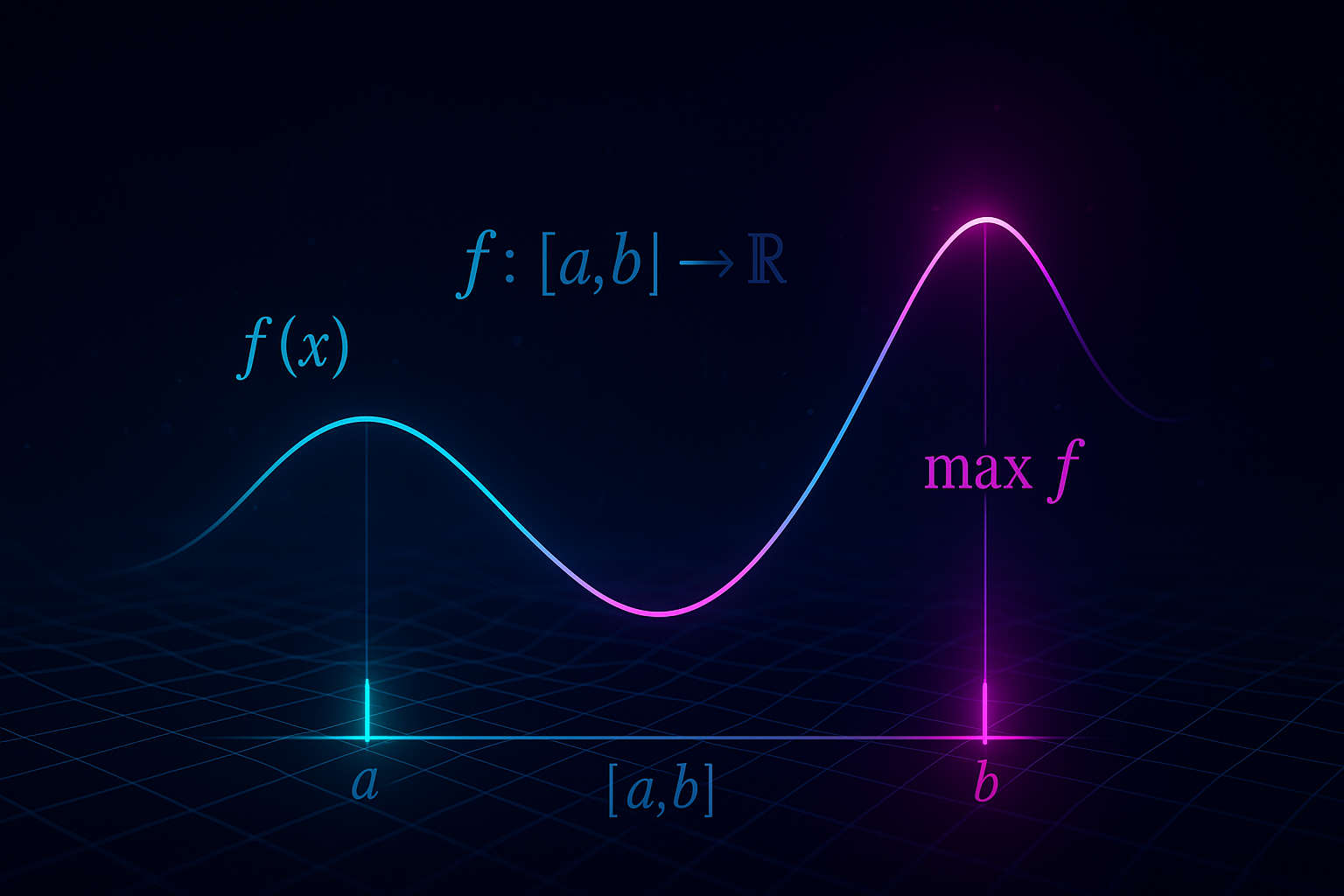
Weierstrass Extreme Value Theorem Why is it that in so many optimization problems it is almost taken for granted that “the maximum exists” or that “there is always a minimum” on a given interval, when in reality nothing forces that to be the case? The Weierstrass Theorem is the missing...
Maximum and Minimum Values of a Function Where is the “best” point of a function: the maximum you want to achieve or the minimum you need to avoid? That question, which arises in optimization, physics, economics, and engineering, is one of the main applications of differential calculus. And here is...
Divisibility Divisibility is the true starting point of number theory because it turns the integers into a structured system: numbers are no longer viewed merely as “quantities”, but as elements that either fit together or do not. With a single relation, , it is possible to express everything from simplification...
The Division Algorithm In this class we will develop the division algorithm as the principle that formalizes, for integers, the unique decomposition with . The existence of the quotient and the remainder is first proved, and then their uniqueness. Finally, the meaning of the remainder is interpreted, the theory is...