

Asymptotes, Limits, and Graphing Techniques
Summary:
In this class, we address the concepts of asymptotes and dominant terms in the analysis of functions. We explore horizontal asymptotes, which describe the behavior of a function as x tends to infinity; vertical asymptotes, which indicate infinite limits when x approaches certain values; and oblique asymptotes, relevant in rational functions when the degree of the numerator exceeds that of the denominator. We also analyze the dominant term of a function, which provides an approximation for large values or values near certain points of x.
Learning Objectives
By the end of this class, the student will be able to:
- Understand the concept of horizontal asymptotes and their application in analyzing the behavior of functions as x tends to infinity.
- Identify the conditions for the existence of vertical asymptotes and apply them to the study of functions with infinite limits as x approaches certain values.
- Analyze the occurrence of oblique asymptotes in rational functions when the degree of the numerator exceeds that of the denominator.
- Apply the concept of dominant term to approximate the behavior of functions for large values of x or values near certain points.
- Explain how the analysis of asymptotes and dominant terms contributes to understanding the overall behavior of functions.
CONTENTS INDEX:
Introduction
Horizontal Asymptotes and Limits at Infinity
Vertical Asymptotes and Infinite Limits
Oblique Asymptotes, Curves, and Dominant Terms
Solved Exercises
Proposed Exercises
Introduction
The limits we have reviewed so far allow us to define some useful concepts to understand the global behavior of functions: dominant terms, as well as horizontal and vertical asymptotes. These are, so to speak, curves that the graph of a function tends to approximate as closely as desired as x approaches a certain value.
Horizontal Asymptotes and Limits at Infinity
If f(x) is a function defined on ]a,+\infty[, for some a\in\mathbb{R}, then it is possible to calculate the limit of f as x tends to infinity. If such a limit exists, then from it we define the right horizontal asymptote as the line given by the equation
A_+(x) = L^+
where
\displaystyle \lim_{x\to+\infty}f(x) = L^+
Similarly, we define the left horizontal asymptote as the line given by the equation
A_-(x) = L^-
when
\displaystyle \lim_{x\to-\infty}f(x) = L^-
Horizontal asymptotes help describe the behavior of the function f(x) as the values of x grow without bound.

Vertical Asymptotes and Infinite Limits
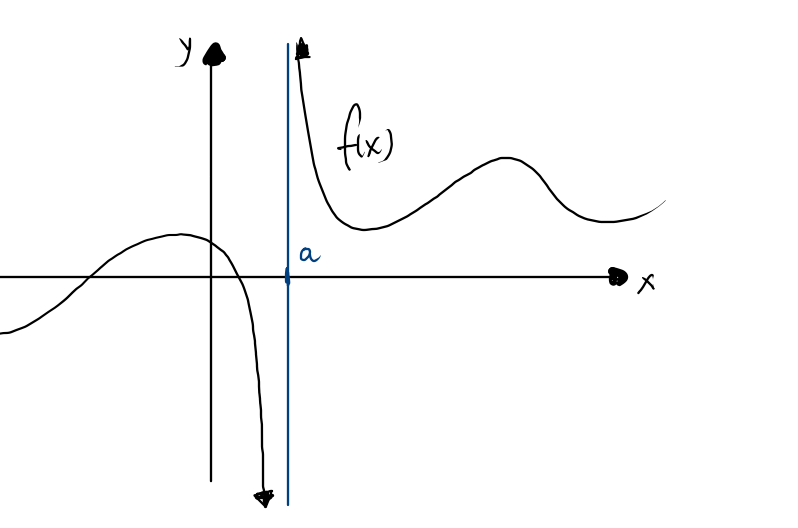
Similarly to horizontal asymptotes, we define the vertical asymptotes upward of a function f(x) as the line given by the equation x=a when
\displaystyle \lim_{x\to a}f(x) = +\infty
And the asymptote will be vertical downward if
\displaystyle \lim_{x\to a}f(x) = -\infty
And following the logic of one-sided limits, the asymptotes will be to the right or to the left as appropriate.
Oblique Asymptotes, Curves, and Dominant Terms
The simplest occurrence of oblique asymptotes happens when dealing with rational functions
f(x) = \dfrac{P(x)}{Q(x)}
Where P(x) and Q(x) are polynomials. When the degree of P(x) is greater than that of Q(x), it is possible to perform polynomial division, resulting in something of the form
f(x) = \dfrac{P(x)}{Q(x)} = C(x) + \dfrac{r(x)}{Q(x)}
Where C(x) is the quotient of the division and r(x) is the remainder. If P(x) has a degree that exceeds that of Q(x) by one, then C(x) will be of degree 1, meaning it will have the form of a line, and it will be called an oblique asymptote of f(x).
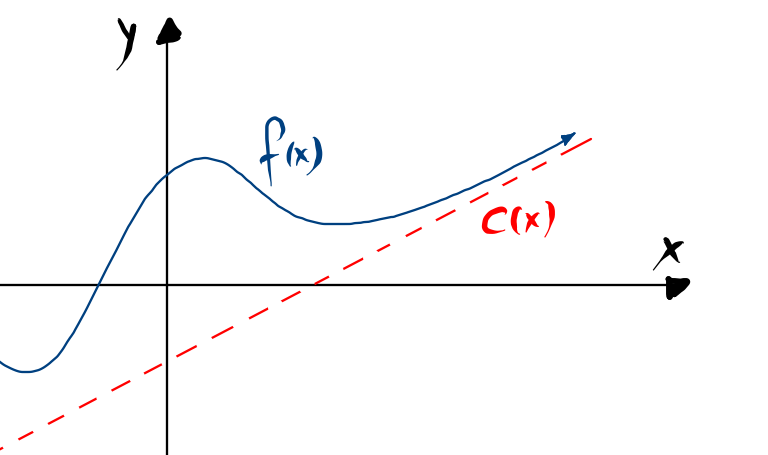
If in general, P(x) has a degree that exceeds that of Q(x) by any magnitude, then C(x) will have a degree equal to the difference in degrees between P(x) and Q(x), and will consequently be a general polynomial curve. In this case, it is not customary to say that C(x) is an asymptote, although the general behavior of f(x) will be to “asymptotically approach” C(x) as x\to\pm\infty. In this case, C(x) is called the dominant term of f(x) for large values of x.
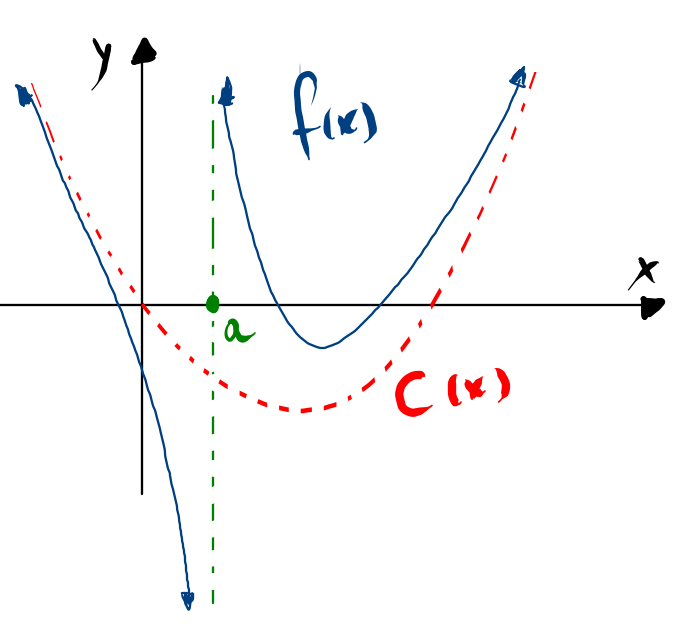
It is also possible to talk about the dominant term when x is near some a\in\mathbb{R}.
If f(x) = P(x)/Q(x) = C(x) + r(x)/Q(x), where P(x), Q(x), r(x) and C(x) are polynomials. If \displaystyle \lim_{x\to a}f(x) = \infty, then the quotient r(x)/Q(x) is called the dominant term of f(x) near x=a.
Solved Exercises
Exercise 1:
Determine the horizontal and vertical asymptotes of the function
f(x) = \dfrac{3x + 1}{x - 2}
Solution:
To find the horizontal asymptote, we calculate the limit of f(x) as x \to \pm\infty:
\lim_{x \to \pm\infty} \dfrac{3x + 1}{x - 2} = 3
Therefore, the horizontal asymptote is y = 3.
For the vertical asymptote, we identify the value where the denominator is zero, which is when x = 2.
\lim_{x \to 2^\pm} \dfrac{3x + 1}{x - 2} = \pm\infty
This indicates a vertical asymptote at x = 2.
Final result: The function has a horizontal asymptote at y = 3 and a vertical asymptote at x = 2.
Exercise 2:
Find the horizontal and oblique asymptotes, if they exist, of the function g(x) = \frac{2x^2 + 3x + 4}{x + 1}.
Solution:
First, we look for the horizontal asymptote by calculating the limit as x \to \pm\infty. Since the degree of the numerator is greater than that of the denominator, there is no horizontal asymptote.
For the oblique asymptote, we perform polynomial division, obtaining the following result:
\dfrac{2x^2 + 3x + 4}{x + 1} = 2x + 1 + \dfrac{3}{x + 1}
Thus, the oblique asymptote is the line y = 2x + 1, which is the dominant term of the function.
Final result: The function does not have a horizontal asymptote but has an oblique asymptote at y = 2x + 1.
Exercise 3:
Calculate the vertical asymptote of h(x) = \frac{5}{x^2 - 4}.
Solution:
To find the vertical asymptote, we identify the values where the denominator is zero, i.e., x^2 - 4 = 0. This occurs at x = \pm 2.
We evaluate the one-sided limits for each value:
\lim_{x \to 2^\pm} \dfrac{5}{x^2 - 4} = \pm\infty and \lim_{x \to -2^\pm} \dfrac{5}{x^2 - 4} = \pm\infty
Final result: The function has vertical asymptotes at x = 2 and x = -2.
Proposed Exercises
- Analyze the function f(x) = \frac{2x^2 - 3x + 1}{x^2 + x - 2}. Determine its horizontal, vertical, and oblique asymptotes, if they exist. Explain each step to reinforce the concept of asymptotes and the calculation of limits.
- Evaluate the function g(x) = \frac{3x^3 + 2x}{x^2 + 1}. Identify the dominant term as x tends to infinity. Then, check if an oblique asymptote exists, justifying your answer.
- Sketch an approximate graph of the function h(x) = \frac{5x - 4}{x + 1}. Include horizontal, vertical, and oblique asymptotes (if they exist) and analyze the behavior of h(x) for extreme values of x.
- Check whether the function k(x) = \frac{x^2 - 4x + 3}{x^2 - 1} has vertical asymptotes. Discuss the role of dominant terms in analyzing the limit of k(x) at values where the function tends to infinity.
- Explore the dominant terms of m(x) = \frac{2x^4 + 3x^2 - x + 5}{x^3 - x^2 + 2}. Determine the behavior of m(x) as x \to \pm\infty, and conclude if it approaches a polynomial curve instead of a line.
- Design a rational function of your choice and describe in detail how to calculate its horizontal, vertical, and oblique asymptotes, as well as its dominant terms. Present your findings using graphs to visualize each type of asymptote.